
Commercial work in Burbank
Commercial locksmith in Burbank, CA
Media district facilities, downtown offices and independent retail — three quite different authorisation processes and three different hardware specifications.
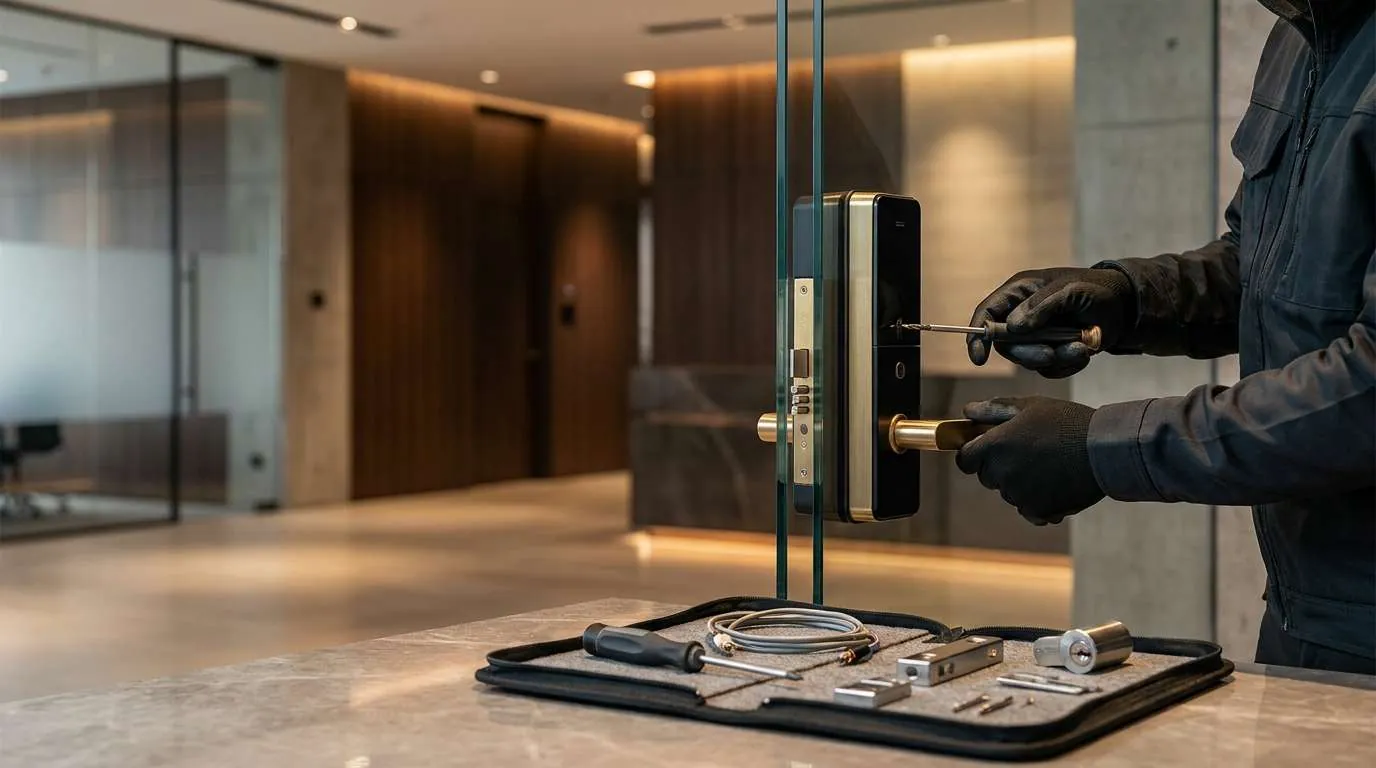
Commercial work in Burbank
Three commercial districts, three ways of working
Burbank's commercial property does not behave as a single category. The media and production district around the studios operates with formal facilities management and defined access procedures. Downtown carries mid-rise offices, retail and restaurants under conventional commercial management. Magnolia Boulevard is a strip of small independent shops where the owner is usually the person on the phone.
Those differences matter more for how a job is arranged than for the technical work itself. A production facility may require scheduling, site induction and written authorisation. A Magnolia Park boutique needs a conversation with whoever owns it.
There is a fourth category worth mentioning: light industrial premises toward the city's edges, where hardware has to be specified for genuinely heavy use rather than borrowed from an office catalogue.

In detail
Specifying for the building rather than the catalogue
The most common reason commercial hardware fails early is that it was chosen for the wrong environment. Burbank makes that easy to illustrate, because four quite different kinds of door sit within a few miles.
A boutique on Magnolia has a narrow-stile glass frontage cycled a few hundred times a day. The binding constraint is alignment and closer adjustment; the cylinder rarely fails first.
A downtown office suite has conventional commercial lever hardware on interior doors and a controlled lobby outside. The useful question is usually which internal rooms should come off the suite key.
A production facility may have controlled access, restricted areas and specific procedures around who may enter what. Hardware choices there follow the site's own standards more than general practice.
A light industrial unit has steel personnel doors beside roll-up openings, facing high cycle counts, sudden loads, dust and wide temperature swings. Commercial-grade lock bodies, correctly sized closers, exit devices matched to the door, and exterior-rated cylinders are the baseline. Residential hardware on these doors typically fails within a year.
Options
Hardware by premises type
Narrow-stile storefront
Hook bolt or mortise in an aluminium frontage. Alignment and closer adjustment dominate.
Commercial lever hardware
Suite and interior doors. Specify a commercial grade rated for the cycle count.
Exit devices
Required exit doors must allow egress without a key, code or special knowledge.
Heavy-duty closers
Sized for the door, adjusted so the latch actually engages rather than just closing quietly.
Exterior-rated cylinders
For industrial and service doors where dust and weather reach the keyway.
Master-key schemes
Designed from a chart of who needs which doors before any pinning is done.
Credential access
Where staff change frequently and revoking access should not require a site visit.
Door-position switches
On service and loading doors, where the usual failure is a door left ajar rather than a defeated lock.

Common cases
Commercial calls across the city
A Magnolia Boulevard shop door that will not latch
Closer and alignment on a narrow-stile frontage.
A production facility with formal access procedures
Authorisation and scheduling established before anything is arranged.
A downtown suite with internal rooms on the front-door key
Separating those doors, or moving them to a logged credential.
An industrial personnel door failing repeatedly
Almost always under-specified hardware rather than bad luck.
Staff turnover at a small business
Targeted rekeying of the cylinders that person held.
A rear service door onto an alley
Should be treated as an exterior door regardless of how it feels.
Before you call
What helps when you call
- Which district and what kind of premises
- How many doors are involved, and of what construction
- Who holds authority to approve the work
- Whether the site has its own access procedures or standards
- Whether any door is a required exit or part of a fire-rated assembly
- How often staff change, and how access is currently revoked
- Whether any credential system already exists
- Photographs of the doors and their existing hardware
Process
How the visit runs
Describe it
The property or vehicle, the hardware involved, and what changed before the problem started.
Confirm the service
We confirm what applies and what the technician needs to bring, including how authorisation will be shown.
Diagnose on site
The hardware and the whole opening are inspected before anything is replaced.
Complete and test
Everything is tested in place before the visit ends.
Common questions
Burbank commercial questions
Request commercial locksmith work in Burbank
Tell us which district, what kind of premises, and who can approve the work.
Identification is required
For any work that provides access to a property, vehicle or safe, the technician will ask for photo identification and evidence that you are entitled to enter. Having that ready keeps the visit short.