
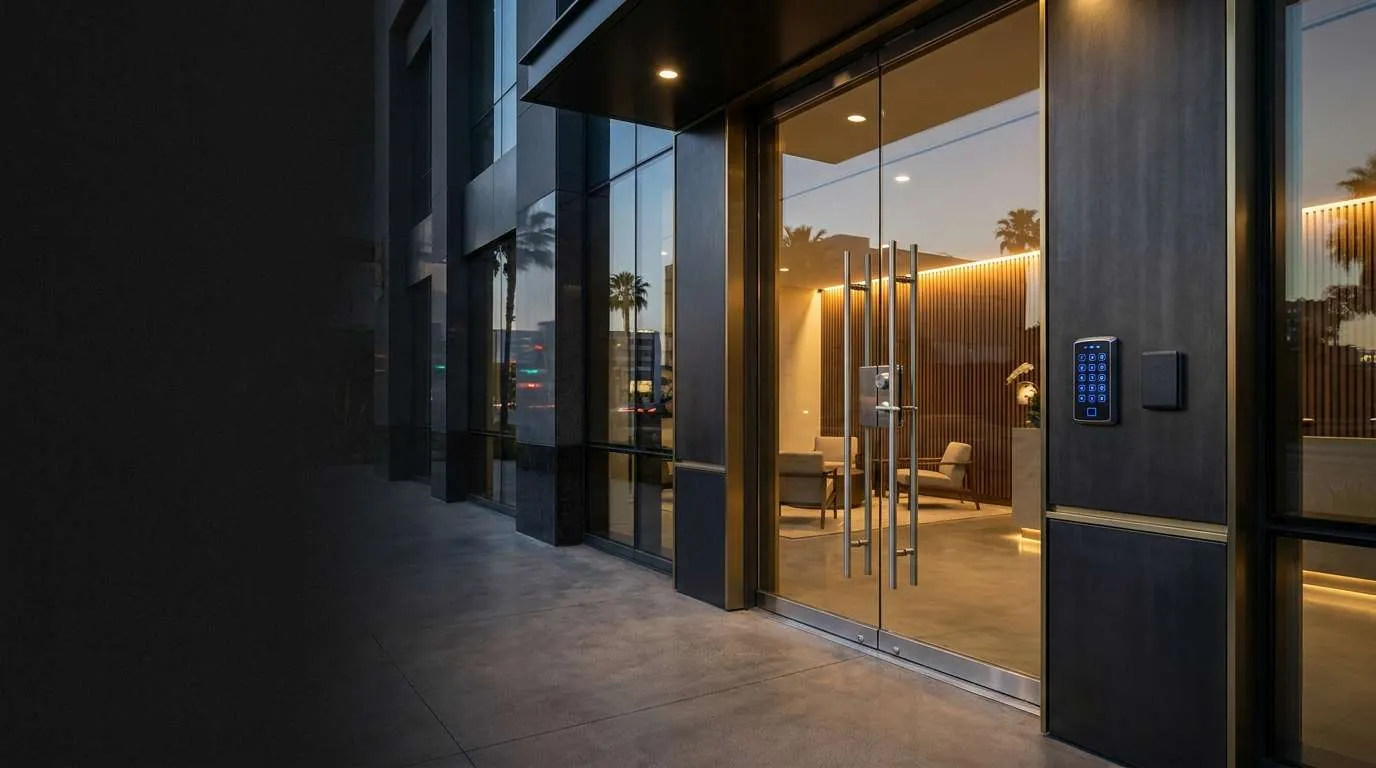
Commercial
Commercial locksmith services in Los Angeles, CA
Storefront and office door hardware, master-key planning, panic bars, closers, commercial rekeying and access control — work scoped around how a building is actually used.
Commercial locksmith work
A commercial door is a system, not a lock
On a house, a deadbolt works more or less in isolation. On a commercial opening it never does. The lock shares the job with the hinges or pivots, the frame, the closer, the strike or keeper, any exit device, any electric release, and whatever access-control hardware has been added since. Change one part without looking at the others and the original symptom tends to come straight back.
Traffic is the second difference. A shop entrance may cycle several hundred times a day. Fasteners loosen, closers lose adjustment, latches wear, and aluminium doors sag out of square. What would take a decade on a front door happens in a season.
The third is that commercial security is largely an administrative problem. People join, leave, change roles and hand over responsibilities. The hardware has to make it practical to keep up with that — which is why the useful conversation is usually about who needs which doors, not about which lock to buy.
Property types
The kinds of premises this covers
Retail and storefront
Aluminium and glass entrances with mortise or hook-bolt hardware, roll-down security, back-of-house doors and stockroom access. Alignment is the recurring theme, because these doors move.
Offices and suites
Suite entrances, individual offices, server and records rooms, and shared corridors. Usually the best candidates for a master-key scheme, because the access hierarchy mirrors the organisation chart.
Multi-tenant and managed buildings
Common entrances, lobbies, mail rooms, parking and amenity areas. Work here is authorised by the building rather than by individual tenants, and credential systems usually make more sense than keys.
Industrial and warehouse
Roll-up doors, personnel doors, gates and yard access. Heavier hardware, harsher conditions, and a stronger case for exit devices and door position monitoring.
Hospitality and food service
High cycle counts, staff turnover and cash-handling areas. Frequent credential changes make electronic access particularly worthwhile.
Medical and professional practices
Records rooms, dispensaries and treatment areas where restricting access is a compliance matter as much as a security one, and an audit trail has real value.

A master key that can be copied at a hardware counter is not really a master key.
Key control
Master-key systems: design before pinning
A master-key system lets one cylinder be opened by more than one key. The day-to-day key for that door is the change key; above it sit one or more master levels that open progressively larger groups of doors.
The pinning is the easy part. The design is what matters. It starts as a chart: every door on the site down one axis, every role across the other, and a mark where a role needs a door. That chart exposes the things people miss — the cleaner who needs every office but no records room, the delivery driver who needs the rear door only, the contractor who needs one plant room for three weeks.
Two decisions shape the scheme more than any other. The first is how many master levels you genuinely need; every additional level adds shear lines to each cylinder, and past a point that reduces both security and mechanical reliability. The second is whether to use a restricted keyway, where blanks are controlled and duplication requires written authorisation. Without that, a master key can be copied at any hardware counter and the scheme's value drains away quietly.
A well-documented system also survives staff changes. Keeping the chart and the pinning record means a future change — a new door, a departing manager, a re-pinned level — can be made without reverse-engineering the whole site.
Hardware
Commercial door hardware, and what each part does
Most commercial faults trace back to one of these parts fighting another. Knowing which is which shortens the diagnosis considerably.
Mortise lock body
A single unit inside the door edge carrying latch, deadbolt and trim. The workhorse of commercial doors: serviceable, rebuildable and available in many functions.
Cylindrical lever lock
Through-bored lever hardware for offices and interior doors. Graded for cycle life; specifying a commercial grade rather than a residential one is what determines how long it lasts.
Storefront hook bolt
Narrow-stile hardware for aluminium and glass entrances. The hook engages a keeper in the jamb, which makes alignment critical — a sagging door stops the hook meeting the keeper at all.
Exit device (panic bar)
Allows exit under pressure with no key or code. Available as rim, mortise, surface vertical rod and concealed vertical rod, each suited to different door and frame configurations.
Door closer
Controls closing speed and latching force. If the closer is not bringing the door fully home, the latch never engages properly — and the lock gets the blame.
Electric strike
Replaces a fixed keeper with one that releases on a signal. Works with the existing latch, so the mechanical lock stays in place and the door keeps a key override.
Magnetic lock
Holds the door with an electromagnet and has no latch at all. Requires release devices and life-safety provision, because the door is only secure while it is powered.
Door position switch
Reports whether a door is actually closed. Cheap, frequently omitted, and the only way to know that a door was left propped open.
Common calls
What businesses usually call about
The front door has stopped locking
Almost always alignment on a storefront: the door has dropped, or the closer no longer pulls it fully into the frame, so the bolt misses its keeper.
Staff turnover
Keys not returned, or credentials that need withdrawing. Mechanical rekeying for keys; a software change for cards and fobs.
A new tenancy is starting
Rekeying before occupation, working out how many keys are needed, and deciding whether a master scheme is worth setting up from the start.
The panic bar sticks or does not latch
Either the device needs servicing or the opening has moved. A bar that will not latch leaves the premises unsecured overnight.
The door closer slams or drags
Closer size, mounting or adjustment. A slamming door damages hardware and frames; a dragging one stops the latch engaging.
Access needs an audit trail
Where a record of who entered which area matters, credentials with logging are the practical answer rather than more keys.
Choosing an approach
Keys, credentials, or both
Most sites end up running both, and that is usually the right answer rather than a compromise.
Mechanical keys need no power, no network and no administration. They work during an outage, they cost almost nothing per door, and they are entirely understood by everyone who uses them. Their weakness is change: every time somebody leaves with a key, the response is physical work on cylinders.
Electronic credentials invert that. Adding or removing a person takes seconds, access can be limited by time of day, and the system knows what happened. The cost is infrastructure — readers, controllers, power, and somebody who owns the administration — plus a real dependency on that infrastructure staying up.
A common arrangement is electronic credentials on the doors that see frequent personnel change, mechanical keys on plant rooms and low-traffic areas, and a documented mechanical override on the main entrance so the building can still be opened when the system is down.
Where life safety constrains the choice
Required exit doors must permit egress without a key, code or special knowledge. That rules out certain arrangements outright, regardless of how convenient they would be. Magnetic locks in particular require release provisions and fail-safe behaviour on loss of power. Fire-rated assemblies are more constrained again: modifications generally require listed components and may need the involvement of the authority having jurisdiction. Where a proposed change runs into these limits, we will say so rather than fit it.
Process
How a commercial job is scoped
Larger jobs go wrong when they start from a product rather than from the building. This is the order that avoids that.
Walk the doors
Every opening in scope is looked at: hardware, condition, traffic, and who currently has access to it.
Map the access
Who needs which doors, when, and what happens when that changes. This is the chart a master-key scheme or credential system is built from.
Specify and confirm
Hardware and approach are proposed against that map, including any life-safety constraints that rule options out.
Install, test, document
Hardware is fitted and tested under real conditions, and you are left with a record of the scheme rather than a set of unlabelled keys.
Before you call
Useful information for a commercial enquiry
Commercial work is easier to scope accurately over the phone than residential work, provided a few things are known up front.
- How many doors are involved, and what kind (glass storefront, timber, metal)
- Whether the premises are owned, leased, or part of a managed building
- Who is authorised to approve work on those doors
- Roughly how many people need access, and how often that changes
- Whether any door is a required exit or part of a fire-rated assembly
- Whether there is existing access-control or alarm equipment
- What the current hardware looks like, ideally photographed
- Whether the site already runs a master-key scheme
Common questions
Commercial locksmith questions
Request commercial locksmith service
Tell us how many doors are involved, what kind of premises, and who is authorised to approve the work.
Identification is required
For any work that provides access to a property, vehicle or safe, the technician will ask for photo identification and evidence that you are entitled to enter. Having that ready keeps the visit short.