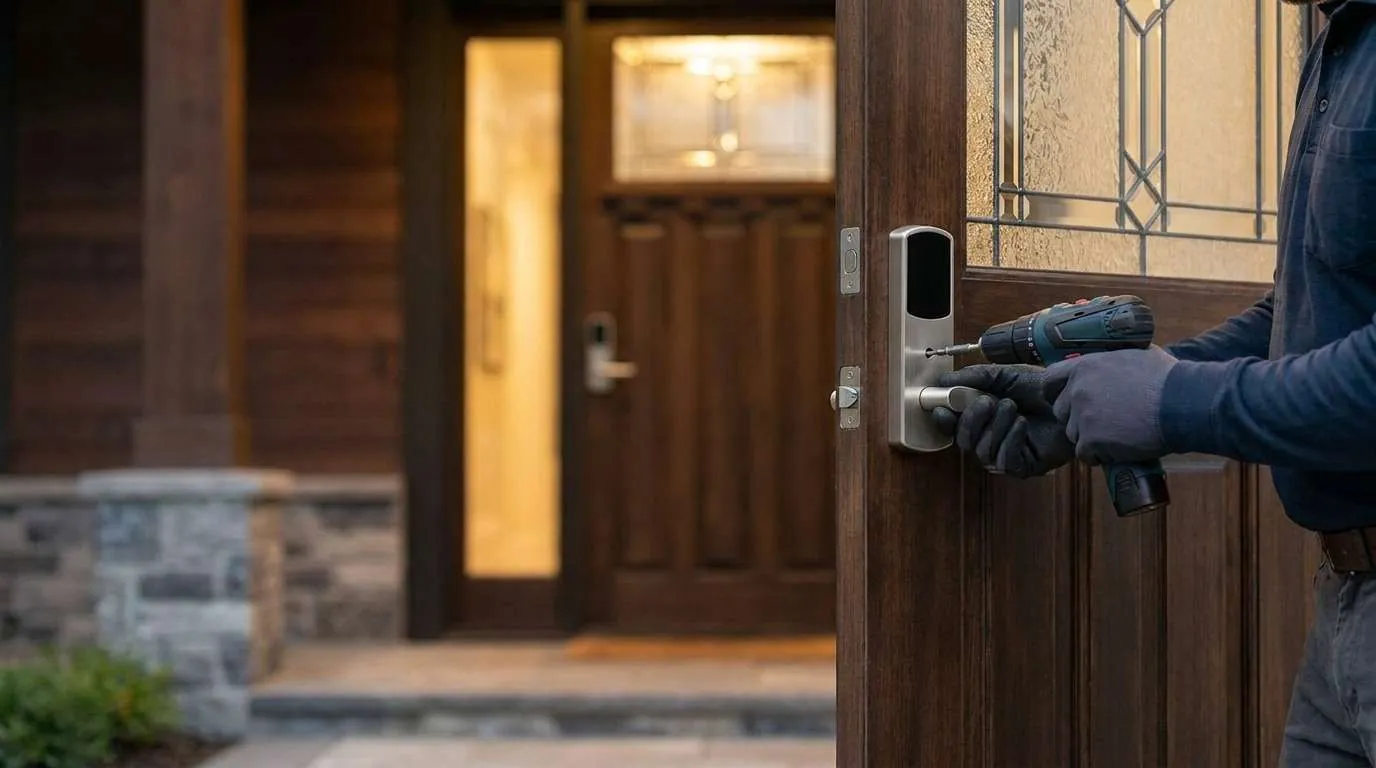
Residential Locksmith Services
Rekeying, lock repair and replacement, smart locks and authorised house lockouts for homes, condominiums and rental property.

Service area
A predominantly residential area either side of Burbank Boulevard, with a college campus at its centre and a steady rhythm of rental turnover.
Valley Glen locksmith
Valley Glen occupies the flat ground between Valley Village and Van Nuys, either side of Burbank Boulevard. It is largely residential and mostly post-war: single and two-storey homes on regular streets, interspersed with apartment buildings from the sixties and seventies.
Los Angeles Valley College sits at the heart of the area, and its presence shapes the local housing market. A meaningful share of the surrounding apartments and rooms are let to students on academic-year terms, which produces a distinct seasonal pattern: a concentrated burst of turnover work in late summer, and another smaller one at the mid-year break.
Alongside that, the single-family streets behave like the rest of the post-war Valley — sixty-year-old doors, original strikes, and the alignment problems that come with both.
Local context
The residential grid is typical of the mid-century Valley: modest single-storey homes with attached garages, on flat streets with good access. The hardware is generally unremarkable, which is exactly why the recurring faults are so predictable — dropped doors, worn strikes, and deadbolts that have never been adjusted since installation.
The apartment stock is concentrated along the larger streets and near the campus. These buildings turn over more often than the Valley average and on a more compressed schedule, which makes planning ahead genuinely worthwhile. A landlord who books rekeying for a run of units in one visit gets through it far faster than one calling unit by unit in September.
Because a good proportion of tenants are students, key loss is more common here than in longer-term housing. That is a practical argument for keypad entry on unit doors in some buildings: a code can be changed in seconds and costs nothing to reissue.

In practice
Where tenancies follow an academic calendar, turnover is not a series of surprises — it is a schedule that is known months in advance. Treating it that way changes both the cost and the disruption.
The reactive version looks like this: a tenant leaves, the landlord notices, a locksmith is called for one door, and the process repeats a dozen times across six weeks. Each visit carries its own travel and setup, and the work always happens under time pressure because the next tenant is waiting.
The planned version books the whole run into one or two visits, in the window between tenancies. Per door it is substantially quicker, because the cylinders are compatible and the technician is already set up.
Two preparatory decisions make this work. First, standardise the keyway across the building so every cylinder is interchangeable. Second, keep a simple record of which key pattern is in which unit, so each change starts from a known position. Neither takes long to set up, and both keep paying back on every subsequent turnover.
For buildings where keys are lost often, it is worth asking whether keypad entry on unit doors would be cheaper over a few years than repeated rekeying. Reissuing a code costs nothing; recutting keys and re-pinning cylinders does not.
Services
Each service page explains the work in full. The order below reflects what comes up most often in this part of the service area.
Rekeying, lock repair and replacement, smart locks and authorised house lockouts for homes, condominiums and rental property.
Assistance when a door, vehicle or safe cannot be opened, or when a lock has failed and the opening needs securing.
Car key replacement, transponder and fob programming, ignition work and authorised vehicle lockouts.
Readers, controllers, electric strikes and magnetic locks for buildings that manage entry with credentials rather than keys.
Storefront and office door hardware, master-key planning, panic bars, closers and commercial rekeying.
Camera placement, cabling, recorder setup and remote viewing for homes, offices and multi-unit property.
Common calls
A sample of the calls that come from this part of the service area.
Planned rekeying across several apartments in one visit, rather than unit by unit over several weeks.
Rekeying rather than just cutting a replacement, because a lost key near home is a lost key that can be connected to an address.
A strong case for keypad entry, where reissuing access costs nothing and takes seconds.
The door has dropped. Hinge screws and strike position, not a new cylinder.
Non-destructive entry after ownership is confirmed; parking density makes the exact location useful.
Closer adjustment and alignment before anyone looks at the cylinder.
On the ground
What a technician meets in Valley Glen depends heavily on which part of the area the property is in.
Academic-year tenancies produce concentrated turnover in late summer. Booking several units into one visit is considerably more efficient than calling individually.
Flat, regular streets with mid-century homes. The usual pattern of doors that have dropped and strikes that no longer line up.
Where key loss is frequent, a code that can be changed in seconds costs nothing to reissue and removes the recurring expense of lost keys.
Small commercial units along the main corridor, with the usual glass-frontage hardware and closer wear.
Concentrated parking around the college, which is where vehicle lockout and key calls tend to come from.
Process
The property or vehicle, the hardware involved and what changed. Photographs of the lock face and door edge help.
We confirm which service line applies and what the technician needs to bring, including how authorisation will be shown.
The hardware and the whole opening are inspected before anything is replaced.
Locks, keys or credentials are tested in place before the visit ends.
Coverage
Neighbouring communities with their own pages. Each describes the property types and lock work common to that area.
Common questions
Tell us the address or neighbourhood, the hardware involved and what it is doing.
For any work that provides access to a property, vehicle or safe, the technician will ask for photo identification and evidence that you are entitled to enter. Having that ready keeps the visit short.