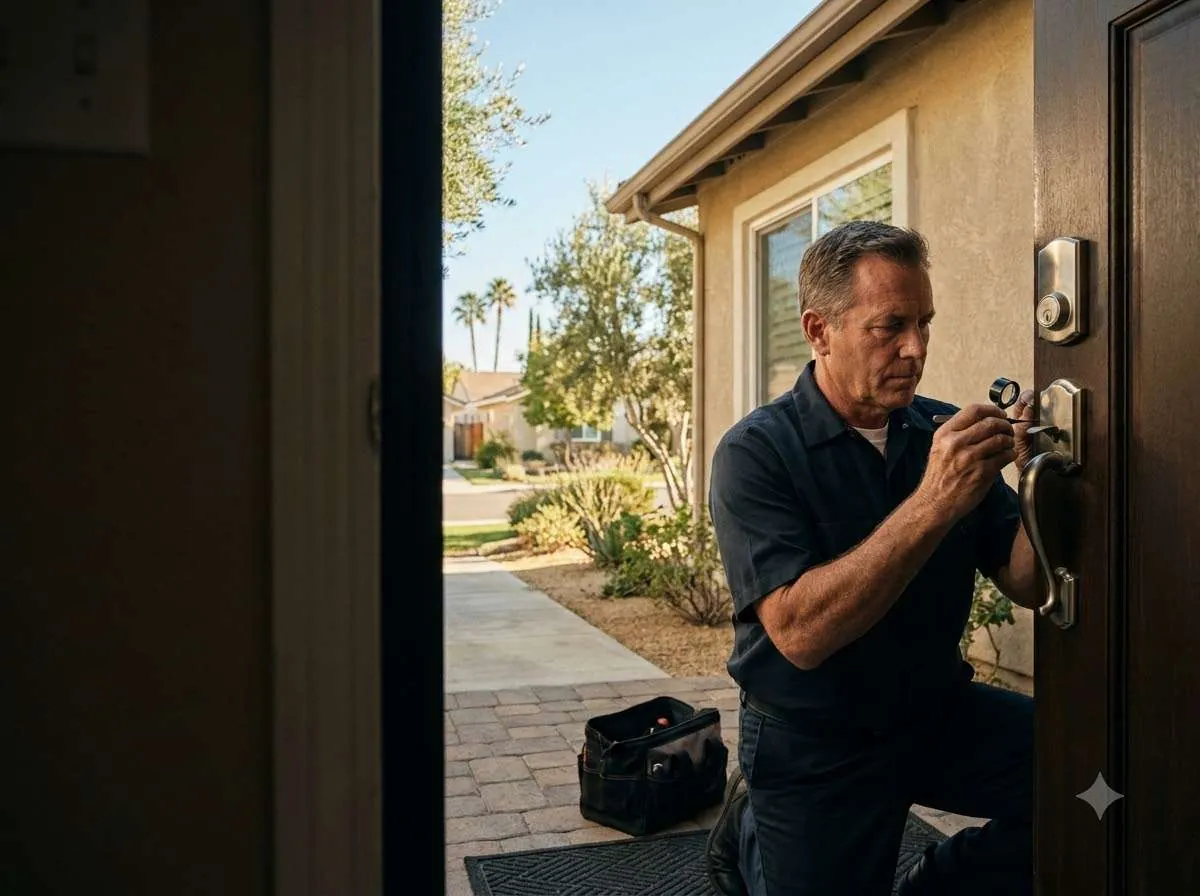
Residential Locksmith Services
Rekeying, lock repair and replacement, smart locks and authorised house lockouts for homes, condominiums and rental property.

Service area
A residential area wrapped around the Sepulveda Basin, with post-war housing and a strong pattern of yard and gate access work.
Lake Balboa locksmith
Lake Balboa takes its name from the lake in the Sepulveda Basin, and the neighbourhood wraps around the recreation area on its eastern and southern sides. It was carved out of the wider Van Nuys area as a distinct community, and it is almost entirely residential in character.
The housing is predominantly post-war single-family, laid out on flat, regular streets, with apartment buildings along the larger roads. Lots are reasonably generous by Valley standards, and most properties have a side gate and an enclosed rear yard — which turns out to matter a great deal for the kind of work that comes up here.
Proximity to the basin also means more properties than usual back onto open space or park land, and rear and side access becomes a more significant part of the security picture than it would be on a street of front-facing houses.
On the ground
What a technician meets in Lake Balboa depends heavily on which part of the area the property is in.
The most common weak point locally. Gates move, take weather, and are almost always fitted with hardware chosen for price rather than conditions.
Flat streets with mid-century housing, original hardware and the familiar pattern of alignment-driven faults.
Back entrances that see less use and less attention, often with the oldest hardware on the property.
Along the larger roads, with turnover rekeying and a single owner or agent authorising work.
Where rear access is more exposed, gate hardware and camera coverage both carry more weight.
Common calls
A sample of the calls that come from this part of the service area.
The gate has dropped or the post has moved. Hardware alone rarely fixes it.
Frequently the oldest and weakest hardware on the property, despite being the least visible entrance.
Rekeying everything, on the assumption that keys have circulated widely over the years.
Exposure and dust. A shrouded weatherproof body lasts far longer than an open shackle.
Rear access carries more weight here, which changes where gate hardware and cameras are worth putting.
Unit-door rekeying arranged directly with the owner rather than a management company.
In practice
Almost every property here has a side gate, and almost none of them have hardware chosen for the job.
A gate is not a door. It hangs on posts set in ground that moves with moisture and season. It has no frame holding it square. It is exposed to sun, rain and dust on every surface. And it is usually pushed and pulled rather than operated carefully. Hardware specified for an interior door will be loose within months and useless within a year.
The typical failure is predictable: the gate drops slightly, the latch stops meeting its keeper, somebody starts lifting the gate to close it, and eventually it simply stays unlatched. From then on the rear of the property is open, and because nobody uses the gate deliberately, it can stay that way for a long time before anyone notices.
Fixing it properly means dealing with the gate as well as the latch: checking the posts, correcting the sag, and then fitting hardware rated for exterior use with enough adjustment to tolerate future movement. Where the gate is the main route to a rear yard that is used daily, a keypad is often worth considering — it removes the key from the equation and lets a gardener or pool service have access that can be withdrawn.
The rear door deserves the same attention. On a house where the front door has been upgraded twice, the back door is frequently still on its original hardware — which makes it the obvious way in.

Local context
The single-family streets follow the standard mid-century Valley pattern: single-storey homes, attached garages, and hardware that in many cases has never been changed. The predictable faults follow — doors that have dropped, strikes that no longer line up, and deadbolts that have been fighting their geometry for years.
What distinguishes the area is the amount of secondary access. Side gates, rear gates, garden doors, detached garages and back entrances are the norm rather than the exception, and these are consistently the weakest points on an otherwise well-secured property. They receive less attention, cheaper hardware and almost no maintenance.
The apartment buildings along the main roads bring the usual turnover rekeying, and because they are generally small, the owner or a managing agent is the person who authorises work rather than a large management company.
Services
Each service page explains the work in full. The order below reflects what comes up most often in this part of the service area.
Rekeying, lock repair and replacement, smart locks and authorised house lockouts for homes, condominiums and rental property.
Assistance when a door, vehicle or safe cannot be opened, or when a lock has failed and the opening needs securing.
Camera placement, cabling, recorder setup and remote viewing for homes, offices and multi-unit property.
Car key replacement, transponder and fob programming, ignition work and authorised vehicle lockouts.
Readers, controllers, electric strikes and magnetic locks for buildings that manage entry with credentials rather than keys.
Storefront and office door hardware, master-key planning, panic bars, closers and commercial rekeying.
Coverage
Neighbouring communities with their own pages. Each describes the property types and lock work common to that area.
Process
The property or vehicle, the hardware involved and what changed. Photographs of the lock face and door edge help.
We confirm which service line applies and what the technician needs to bring, including how authorisation will be shown.
The hardware and the whole opening are inspected before anything is replaced.
Locks, keys or credentials are tested in place before the visit ends.
Common questions
Tell us the address or neighbourhood, the hardware involved and what it is doing.
For any work that provides access to a property, vehicle or safe, the technician will ask for photo identification and evidence that you are entitled to enter. Having that ready keeps the visit short.