
Safes
Safes locksmith services in Los Angeles, CA
Opening with proof of ownership, lock diagnostics, combination changes, lock replacement and installation planning — for home and office safes.
Safes locksmith work
Safe work begins with identification, not with tools
Almost nothing about a safe job can be decided before the make, model and lock type are known. A mechanical dial and an electronic keypad fail in entirely different ways and are approached with entirely different methods. Fire-resistant safes are built around insulating material that behaves nothing like the steel plate in a security safe. A gun safe, a floor safe and a deposit safe each have their own construction.
That is why the first questions are always the same: what does the plate say, what kind of lock is on the front, and what exactly happens when you try to open it. A dial that spins without resistance suggests something different from a dial that stops correctly but will not retract the bolts.
The second constant is documentation. A safe exists to keep people out, including people standing next to it claiming it is theirs. Photo identification and evidence of entitlement are required before any safe is opened, and that requirement does not bend.
Types
Safe and lock types
Knowing which of these you have determines the method, the tooling and often whether the job is practical at all.
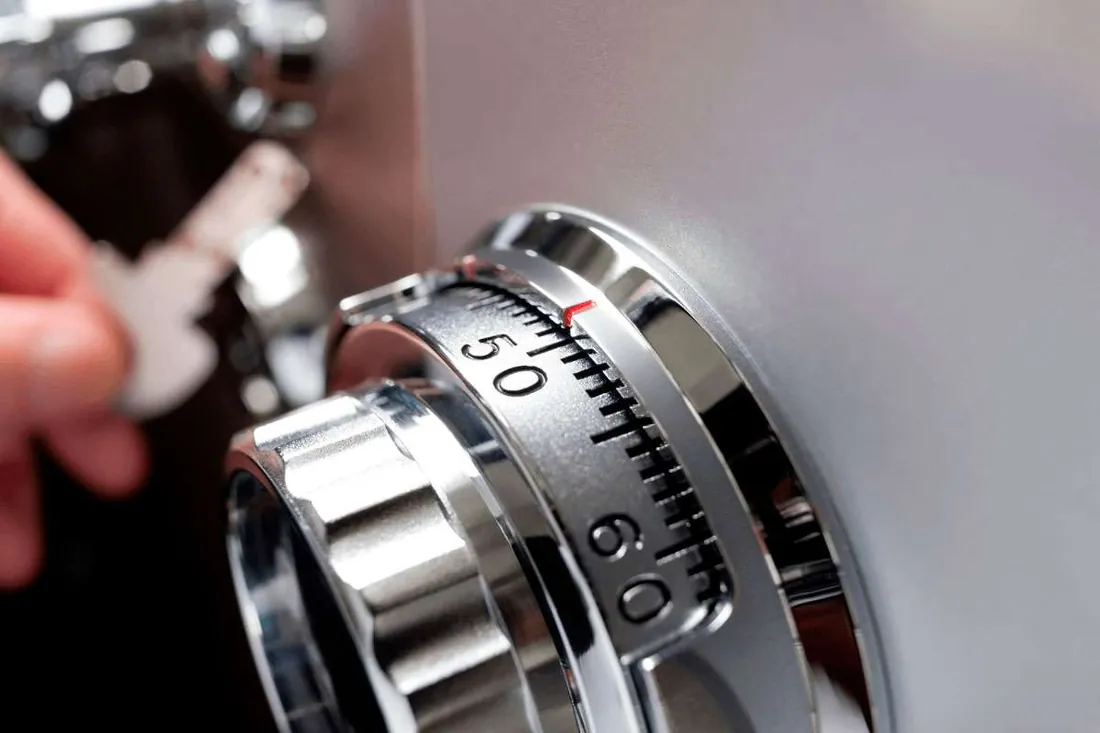
Mechanical dial lock
A three or four-wheel combination lock, entirely mechanical. No batteries, no electronics, and repairable rather than disposable. Fails through wear, dirt or a dropped wheel.
Electronic keypad lock
Combination entered on a keypad driving a small solenoid. Convenient and quick to reprogram. Fails through flat batteries, a broken keypad cable or a worn solenoid.
Biometric lock
Fingerprint entry, usually with a keypad or key backup. Convenience at the cost of a sensor that is sensitive to damage and to how the finger is presented.
Key-operated safe
A straightforward lever or cylinder lock. Simple and reliable, with the obvious dependency on not losing the key.
Fire-resistant safe
Built to protect documents from heat, using thick insulating fill. Good at fire, generally weaker against forced entry than a security safe of the same size.
Security and burglary safe
Heavy plate and bolt work built to resist attack. Usually heavier and smaller inside than a fire safe of similar external dimensions.
Floor and in-ground safe
Set into a slab, protected by the surrounding concrete. Excellent concealment; vulnerable to water and hard to service once installed.
Deposit and drop safe
Allows cash to be deposited without opening the container. Common in retail and hospitality, where several staff need to deposit but few to open.

A safe that survives the opening can go on protecting what is in it.
Opening
Opening a safe: non-destructive first
The aim is always a safe that still works afterwards. There are several routes to that, and which applies depends on the lock and on what has failed.
Manipulation works on some mechanical dial locks by reading the tiny mechanical feedback the wheels give as they are turned. It is slow, it demands patience, and it is not possible on every lock — many modern ones are built specifically to resist it.
Decoding uses the lock's own construction to recover the combination rather than guess it. Manufacturer recovery routes exist for many electronic locks, through a master code or a documented reset procedure. And where a key lock has simply lost its key, a replacement can often be produced from the lock itself.
Drilling is the last resort, not the default. It is precise work: a small hole at a known point that gives sight of or access to the mechanism, chosen to avoid the hardplate and the relockers that are there to punish exactly this approach. Afterwards the hole is repaired and the lock replaced where the safe is worth keeping. You will be told before any hole is made, and told what it means for the safe.
Diagnosis
What the symptom suggests
Describing the symptom precisely on the phone often identifies the fault before anyone travels, and occasionally solves it outright.
| What is happening | Commonly means | First thing to check |
|---|---|---|
| Keypad completely unresponsive | Flat batteries or a failed keypad cable | Replace the batteries with fresh cells before anything else |
| Correct code accepted, bolts do not retract | Solenoid or bolt work rather than the code | Whether the handle moves at all, and in which direction |
| Dial turns with no resistance at any number | A wheel has come loose or the lock has failed internally | Whether the dial ever stops, anywhere in its rotation |
| Dial stops correctly but the handle will not move | Bolt work jam or a triggered relocker | Whether anything was dropped or struck recently |
| Handle moves but the door stays shut | Bolts extended into a frame that has moved, or a jammed item inside | Whether the safe has been moved or something shifted inside |
| Key turns but nothing happens | Worn lock or a detached cam | Whether the key feels different from how it used to |
Batteries are genuinely the most common cause of an electronic safe that has stopped responding. It is always worth trying fresh ones first.
Ongoing work
Combination changes, lock replacement and servicing
Changing a combination is routine work and worth doing on a predictable schedule — after a staff change, after a house move, or whenever more people know the number than need to.
On a mechanical dial lock the change is made with a change key inserted through the back of the lock, with the door open and the old combination dialled. On an electronic lock it is usually a keypad sequence using a master code.
One rule matters more than any other here: test the new combination several times with the door standing open before you close it. Closing a safe on a combination that was mis-set is the single most common way people end up locked out of their own safe, and it converts a five-minute job into a considerably larger one.
Replacing a lock rather than the safe
A worn or failed lock does not condemn the container. Most safe locks are standardised enough that a replacement can be fitted to the existing door, and it is entirely normal to convert between types — a mechanical dial to an electronic keypad, or the reverse for somebody who would rather not depend on batteries. Given the cost and weight of a safe, replacing the lock is usually the sensible economics.
Servicing
Safes are mechanical and benefit from occasional attention. Bolt work can be cleaned and lubricated, dial locks can be checked for wheel wear and drag, hinges can be adjusted, and electronic locks should have batteries replaced on a schedule rather than on failure. A safe that is opened daily in a commercial setting deserves this more than one opened twice a year.
Installation
Installing a safe properly
Choosing size and type
Buy for what you will store in five years, not today. And be clear whether the priority is fire protection or resistance to forced entry — they are different products, and a unit that claims both usually compromises on one.
Where it goes
Somewhere concealed, on a solid floor, with room for the door to open fully. A wardrobe, a closet or a built-in cupboard beats a visible corner of an office. Avoid places prone to damp.
Anchoring
An unanchored safe under roughly 350 kilograms can be trolleyed away and opened elsewhere at leisure. Most safes have base anchor holes; a concrete slab is ideal, and a timber floor may need blocking or reinforcement.
Records
Keep the make, model and serial number somewhere other than inside the safe, along with proof of purchase. This is exactly what is needed to establish ownership if it is ever locked, moved or stolen.
Who knows the combination
Fewer people than you think. Write the number down and store it somewhere secure but not inside the safe — a bank deposit box or with a solicitor. Change it when the list of people changes.
Before you call
What to have ready
Safe work is more information-dependent than any other part of the trade. These details decide the method.
- The make and model from the plate, usually inside the door or on the back
- The lock type: dial, keypad, biometric or key
- Exactly what happens when you try to open it
- Whether anything changed or was struck just before it stopped working
- Whether the batteries have been replaced with fresh cells
- Where the safe is and whether there is room to work around it
- Photo identification and proof that the safe is yours
- A photograph of the front and of the data plate
Common questions
Safe locksmith questions
Request safe locksmith service
Include the make, model and lock type if you can, and describe exactly what happens when you try to open it.
Identification is required
For any work that provides access to a property, vehicle or safe, the technician will ask for photo identification and evidence that you are entitled to enter. Having that ready keeps the visit short.