
Residential
Residential locksmith services in Los Angeles, CA
Rekeying, lock repair and replacement, deadbolts, smart locks and authorised house lockouts — for houses, condominiums, apartments and the secondary doors that tend to get overlooked.
Residential locksmith work
Home security usually comes down to one question: who holds a working key?
Almost every residential locksmith call is a version of that question. A house changes hands and the previous owner's keys are still out there. A tenant moves out and does not return a set. A key goes missing at a restaurant. A relationship ends. A contractor had a key for six months. In each case the locks work perfectly well — the problem is who can use them.
The second most common call is mechanical: a deadbolt that has become stiff, a latch that no longer holds the door, a key that has snapped, a keypad that has stopped accepting its code. These look like hardware failures and sometimes are, but a good proportion turn out to be the door rather than the lock.
Everything below is organised around those two themes: controlling access, and keeping the hardware doing what it was designed to do.
Common situations
When homeowners tend to call
You have just moved in
Nobody knows how many keys exist for a house that has changed hands. Rekeying every exterior cylinder is the standard first step, and it is cheaper than it sounds because the existing hardware stays in place.
A tenant has moved out
Rental turnover is the single most common reason for rekeying. It can be done between tenancies in a single visit, and the same key can be carried across multiple units if the building uses compatible hardware.
A key has gone missing
A lost key is only a problem if it can be connected to an address. If it was on a fob with a tag, or lost near home, rekeying is the sensible response. If it disappeared in another city, the risk is lower.
The lock has become hard to operate
Stiffness that developed gradually usually means wear or alignment. Stiffness that appeared suddenly often means something has moved — a hinge screw, the strike, or the door itself.
A key has broken in the cylinder
The fragment needs removing before anything else can happen. Forcing a spare in behind it makes the extraction considerably harder.
You want to stop carrying keys
Keypad and connected deadbolts remove the key from daily use and make it possible to give a cleaner, a dog walker or a guest a code that can be withdrawn later.
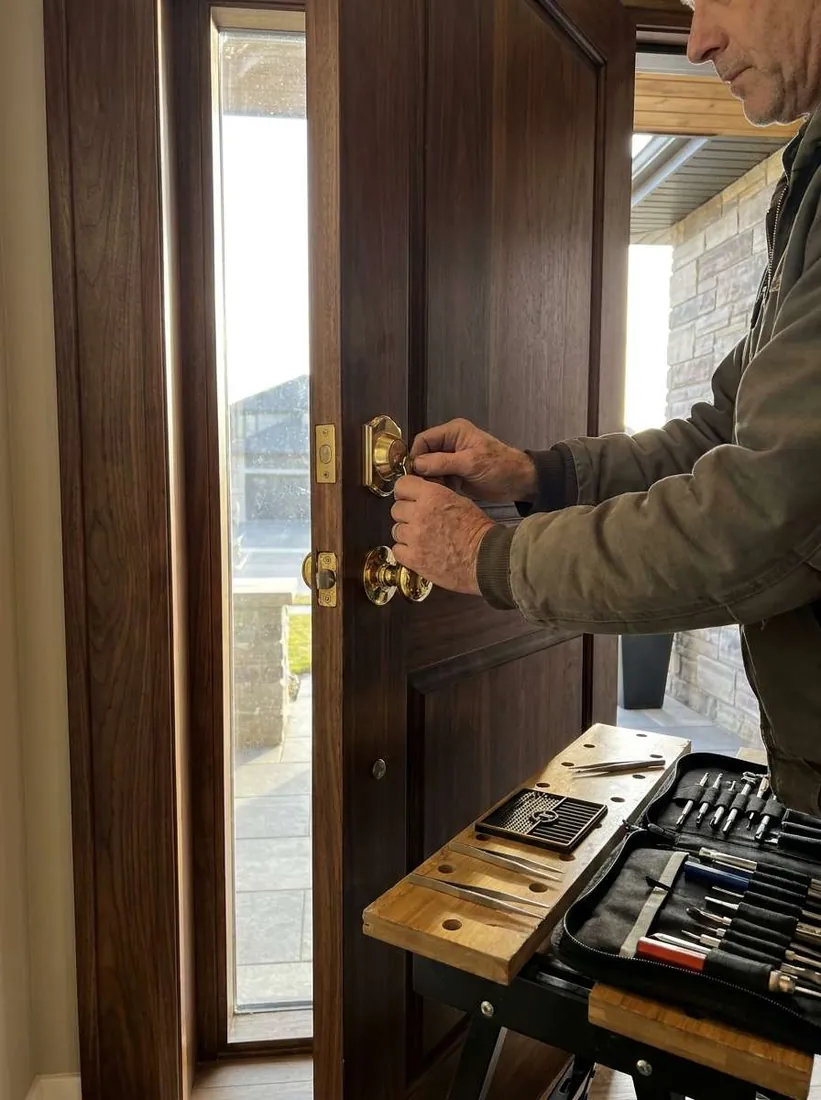
Rekeying changes who can open the door. It does not repair a door that has moved.
Rekeying
Rekeying: changing the key without changing the lock
Inside a standard pin-tumbler cylinder sits a stack of small pins, cut to heights that match the pattern on one particular key. Rekeying means removing the plug, swapping those pins for a different set, and cutting a new key to match. The lock body, the finish and the installation stay exactly as they are.
It takes a fraction of the time of a full replacement, costs less, and produces the same practical result: the old keys no longer open the door. For a house with four or five exterior cylinders that difference is substantial.
Rekeying also allows doors to be brought onto one key. If the front door, back door and side gate use compatible cylinders, all three can be pinned to a single key pattern. Where the hardware is mismatched, swapping one or two cylinders for compatible ones is usually cheaper than replacing everything.
The limits are worth knowing. Rekeying cannot fix a damaged lock body, a worn plug that no longer holds pins reliably, or a door that has dropped. It also cannot be done on some proprietary and low-cost imported cylinders that were never designed to be serviced.
Hardware options
Lock types and what each one is for
Choosing hardware is mostly about matching the lock to the door, the traffic it sees and how much key control you actually need.
Single-cylinder deadbolt
The standard exterior lock: key outside, thumbturn inside. Simple, strong and easy to service. The right default for most front and back doors.
Double-cylinder deadbolt
Keyed on both sides, used where glass sits close enough to the lock to be broken and reached through. Requires care: it prevents key-free exit, which matters in a fire and is restricted in some situations.
Keyed lever and knob sets
Latch-only hardware for secondary doors and interior use. A lever set alone is not adequate security for a main entrance; it belongs alongside a deadbolt.
Mortise lock
A single lock body housing both latch and bolt, fitted into a pocket cut into the door edge. Common on older and higher-end homes, and repairable rather than disposable.
High-security cylinder
Cylinders with hardened inserts, drill and pick resistance, and patented keyways where duplication requires authorisation. Useful where key control genuinely matters.
Keypad deadbolt
Code entry with no phone or network involved. The simplest way to stop carrying a key, and easy to change when a code needs withdrawing.
Connected smart lock
Adds app control, remote access and activity logging. Depends on batteries and usually on a home network, so the mechanical fundamentals matter more, not less.
Sliding-door and window locks
Latches, pins and secondary locks for patio doors and windows. Frequently the weakest point on an otherwise well-secured house.
Repair before replacement
Lock repair, and why the door gets inspected first
A lock is a small machine that has to line up with a hole in a piece of timber or steel. When the two stop lining up, the machine gets blamed.
The diagnostic is straightforward. Open the door and operate the lock in free air. If the bolt throws smoothly and the key turns without resistance, the cylinder and the lock body are healthy, and the problem is at the strike or in how the door sits. If it binds even with the door open, the fault is inside the lock.
Doors move for ordinary reasons. Hinge screws work loose in old timber and the leaf drops a few millimetres. Frames shift with seasonal humidity. Settlement changes the geometry of an opening over years. Any of those can move the bolt far enough out of position to catch the strike.
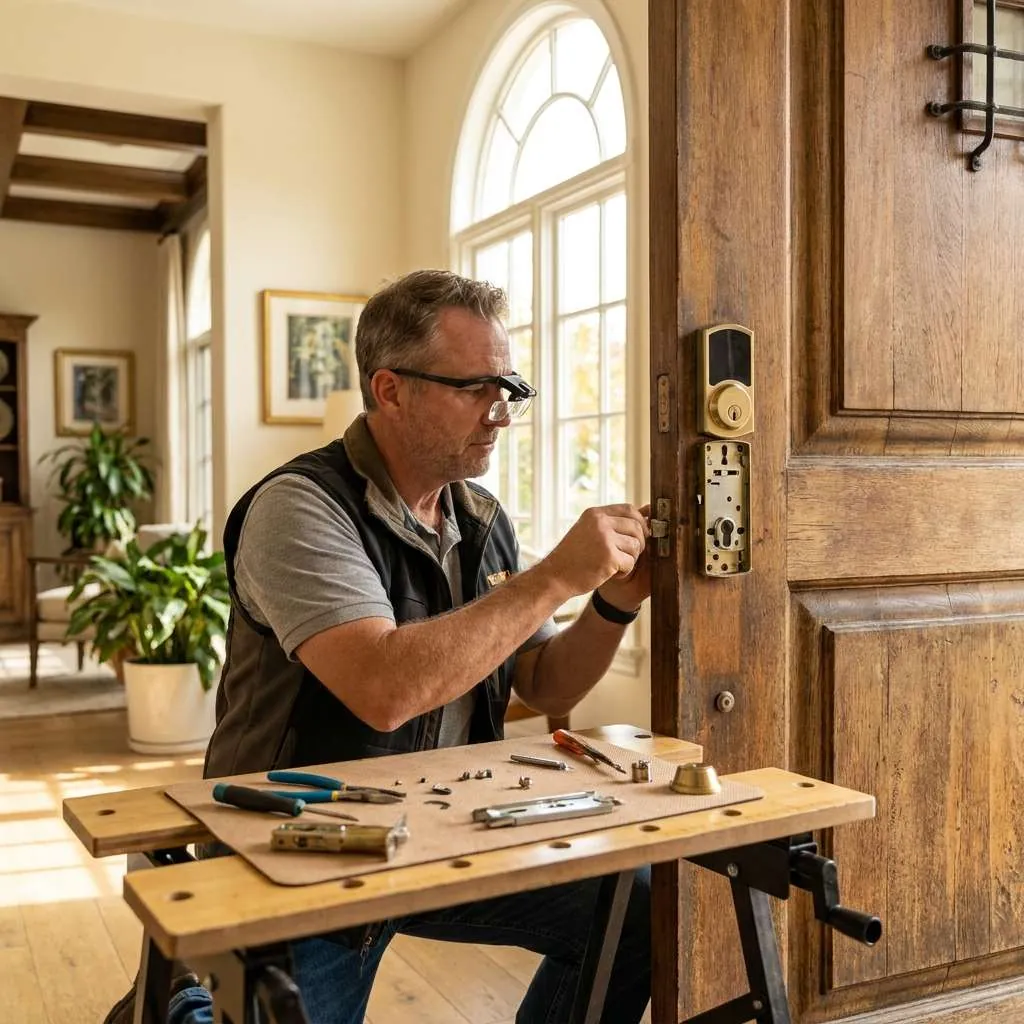
The repairs that follow are usually modest: tightening or replacing hinge screws, sometimes with longer ones that reach the stud; repositioning or enlarging the strike; easing the mortise; adjusting the latch. Where the lock itself is at fault, worn springs, tailpieces and cylinders can often be replaced without changing the whole unit.
Diagnosis
Reading the symptom
Most residential complaints fall into a handful of patterns. Recognising which one you have saves a great deal of unnecessary hardware.
| What you notice | Usually means | Typical response |
|---|---|---|
| Key turns freely with the door open, binds when closed | Door or strike alignment | Adjust hinges, reposition strike, ease mortise |
| Key is stiff in every position | Worn or dirty cylinder, or a worn key | Service or replace the cylinder; cut a fresh key from code |
| Bolt throws only part-way | Obstruction, shallow strike pocket, or a failing lock body | Deepen the pocket or replace the lock body |
| Door will not stay latched | Latch not engaging the strike, or a closer not pulling the door home | Realign the strike; adjust or replace the closer |
| Keypad drains batteries quickly | The motor is fighting resistance at the bolt | Correct the alignment before replacing the lock |
| Key snapped off in the cylinder | Metal fatigue, a worn blade, or resistance inside the lock | Extract the fragment, then find out why it broke |
These are the common cases, not a complete list. A technician confirms the cause on the actual door before recommending work.
Electronic hardware
Smart locks, keypads and electronic entry
Electronic locks solve a genuine problem. They remove the key from daily use, make it possible to issue and withdraw access without handing over hardware, and in most cases keep a record of who came and went.
They also introduce dependencies that mechanical locks do not have: batteries, firmware, sometimes a network, and always a motor. That motor is the critical difference. A hand can force a slightly misaligned bolt without you ever noticing; a small electric motor cannot. This is why so many smart-lock complaints — short battery life, jamming, failure to lock completely — trace back to a door that was never quite right.
The practical order is therefore fixed: check the door preparation, confirm the bolt throws freely into a correctly positioned strike, correct anything that is off, and only then fit the lock. After installation the lock should be tested mechanically, with the door closed, before codes and app access are configured.
Not every door suits one. Non-standard backsets, unusually thick or thin doors, decorative or narrow stiles and metal-clad doors all limit what will fit. Exterior gates add weather exposure and movement. The smart lock installation page covers the compatibility questions in more detail.
Choosing between a keypad and a connected lock
A keypad deadbolt with no network connection is the more robust choice for most homes. It does one thing, it does not depend on a router or a cloud service, and codes can be changed at the door. A connected lock earns its extra complexity when you genuinely need remote access, notifications, or an activity log — a rental property, a second home, or a household with regular visiting help.
Often overlooked
Beyond the front door
Secondary and side doors
Garage side doors, utility entries and back doors are often fitted with cheaper hardware than the front, which makes them the practical weak point. They are also the easiest to bring onto the same key.
Gates and yard access
Side gates take weather, movement and frequent use. Gate hardware needs to be specified for exterior conditions, and the latch has to tolerate a gate that does not close as precisely as a door.
Mailboxes and storage
Cluster mailboxes, individual mailbox locks and storage-unit locks come up regularly, particularly after a move when the previous key was never handed over.
Apartments and shared buildings
In a managed building, the unit door is usually yours to change but common entry doors are not. Work on shared access needs the building's authorisation, and it is worth confirming that before scheduling.
Spare keys and key control
Deciding how many spares exist, and who holds them, is the cheapest security measure available. Restricted keyways prevent casual duplication where that matters.
Before you call
What helps when you get in touch
None of this is essential, but each detail makes it more likely the right parts are on the van when the technician arrives.
- The type of property: house, condominium, apartment or rental
- Which doors are involved, and how many locks in total
- The brand on the lock face if it is visible
- Whether the problem appeared suddenly or developed gradually
- Whether a working key still exists
- For access work, what identification and authorisation you can show
- A photograph of the lock face and the edge of the door
- Whether you want the doors brought onto a single key
Common questions
Residential locksmith questions
Request residential locksmith service
Describe the door, the lock and what changed. Photographs of the lock face and door edge help a great deal.
Identification is required
For any work that provides access to a property, vehicle or safe, the technician will ask for photo identification and evidence that you are entitled to enter. Having that ready keeps the visit short.