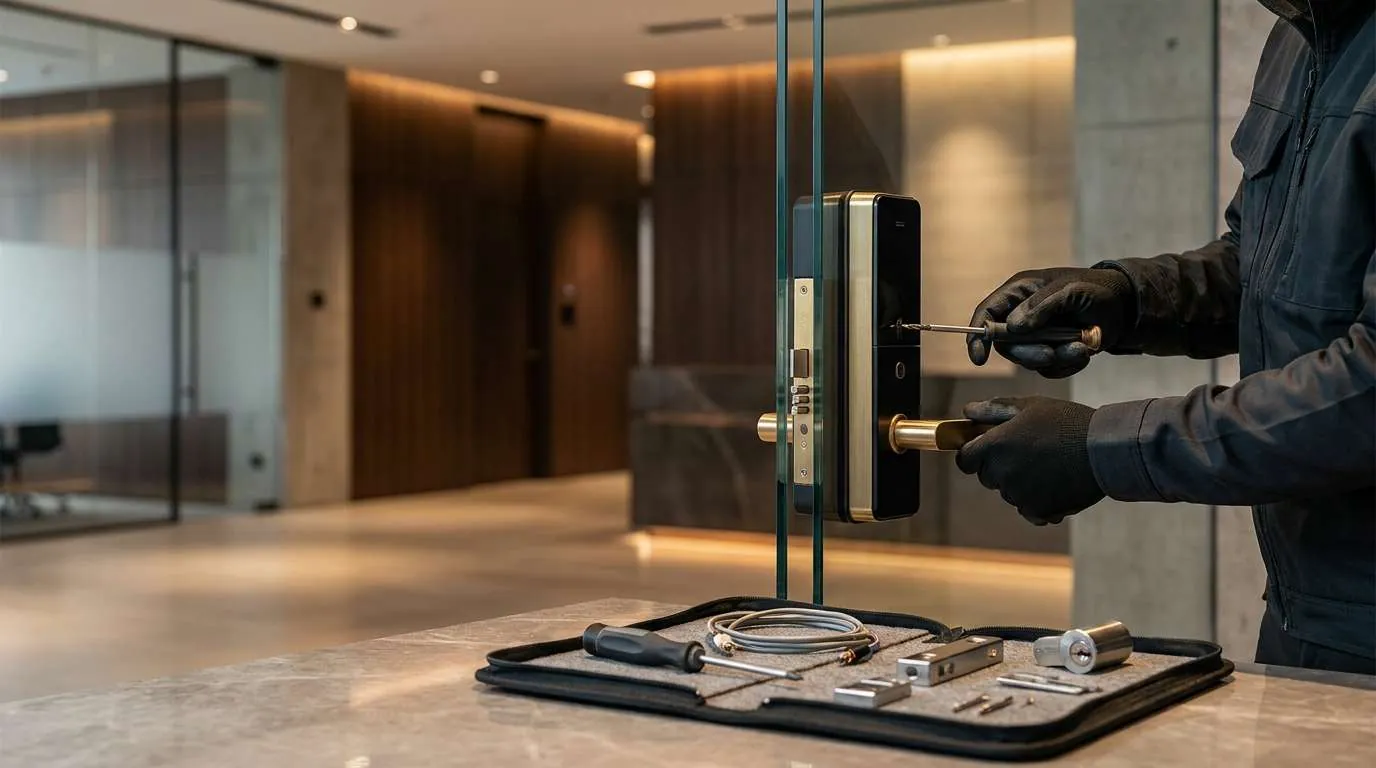
Commercial Locksmith Services
Storefront and office door hardware, master-key planning, panic bars, closers and commercial rekeying.

Service area
A city in its own right, with a media district, a working downtown, and residential neighbourhoods that each have their own character.
Burbank locksmith
Burbank is not a Los Angeles neighbourhood but a separate city, and it behaves like one. It has its own downtown, its own commercial districts, a substantial media and production economy, and residential areas that differ noticeably from one another.
Magnolia Park, in the west, is the most distinctive: a walkable grid of nineteen-twenties to nineteen-forties bungalows and Spanish revival homes behind a commercial strip of independent shops along Magnolia Boulevard. The Rancho district to the south is quite different again, with larger lots, equestrian zoning and properties that include stables and outbuildings.
The media district around the studios brings offices, production facilities and controlled-access buildings, while downtown Burbank carries retail, restaurants and mid-rise offices. A separate commercial locksmith page covers the business side in more depth.
On the ground
What a technician meets in Burbank depends heavily on which part of the area the property is in.
Nineteen-twenties to forties housing with original hardware, where preservation matters as much as security.
Stables, tack rooms, feed stores and outbuildings — exterior hardware exposed to dust, weather and heavy daily use.
Production facilities and multi-tenant offices with controlled lobbies and formal authorisation processes.
Mid-rise offices, retail units and apartment buildings with shared entry and individual unit doors.
Parking structures downtown and around the studios, where vehicle lockout calls commonly originate.
Common calls
A sample of the calls that come from this part of the service area.
Rebuilding the mortise case and reinforcing the strike rather than replacing visible hardware.
Exterior-rated hardware specified for dust and weather, not borrowed from a house door.
Closer and alignment work on a narrow-stile frontage.
Establishing who authorises the work before anything is scheduled.
Non-destructive entry after ownership is confirmed; the level and bay help.
Unit-door rekeying, with the shared entrance remaining the building's responsibility.
In practice
The Rancho district makes a point that applies more widely: the doors people think about least are usually the ones that fail first.
A stable door, a tack-room door, a feed store or a workshop takes conditions no house door ever sees. Dust gets into cylinders and turns lubricant into grinding paste. Temperature swings are wider without insulation. Doors get pushed open with elbows, shoulders and full hands rather than turned politely by a handle. And the contents — tack, tools, feed, equipment — are often worth more than anything in the house that is not bolted down.
Despite that, these openings routinely get whatever hardware was cheapest at the time. A residential-grade lever set on a barn door will be loose within a year and seized within two.
Specifying them properly is not complicated. Exterior-rated cylinders resist dust and moisture ingress. Commercial-grade lever hardware tolerates being shoved. Padlocks belong in weatherproof shrouded bodies rather than open shackles. And bringing the outbuildings onto a shared key — separate from the house — means the people who need them can get in without carrying a key to the residence.
The same logic applies to any property with a workshop, a pool house or a detached garage. Those doors deserve the same thought as the front one.

Local context
Magnolia Park's housing is older than most of the surrounding Valley, which puts original mortise locks and period door furniture into regular circulation. The commercial strip alongside it is made up of small independent units with glass frontages, and the owners are generally the people who authorise work — which makes commercial jobs there quick to arrange.
The Rancho district is unusual for an urban area. Equestrian zoning means properties commonly include stables, tack rooms, feed stores and outbuildings, all of which need locking and none of which behave like a house door. Exterior hardware there takes dust, weather and heavy use.
The media district and downtown are conventional commercial territory: multi-tenant offices, controlled lobbies, parking structures and retail units. Production facilities in particular tend to have specific access requirements, and authorisation for work on them is usually formal.
Services
Each service page explains the work in full. The order below reflects what comes up most often in this part of the service area.
Storefront and office door hardware, master-key planning, panic bars, closers and commercial rekeying.
Rekeying, lock repair and replacement, smart locks and authorised house lockouts for homes, condominiums and rental property.
Car key replacement, transponder and fob programming, ignition work and authorised vehicle lockouts.
Readers, controllers, electric strikes and magnetic locks for buildings that manage entry with credentials rather than keys.
Assistance when a door, vehicle or safe cannot be opened, or when a lock has failed and the opening needs securing.
Camera placement, cabling, recorder setup and remote viewing for homes, offices and multi-unit property.
Coverage
Neighbouring communities with their own pages. Each describes the property types and lock work common to that area.
Process
The property or vehicle, the hardware involved and what changed. Photographs of the lock face and door edge help.
We confirm which service line applies and what the technician needs to bring, including how authorisation will be shown.
The hardware and the whole opening are inspected before anything is replaced.
Locks, keys or credentials are tested in place before the visit ends.
Common questions
Tell us the address or neighbourhood, the hardware involved and what it is doing.
For any work that provides access to a property, vehicle or safe, the technician will ask for photo identification and evidence that you are entitled to enter. Having that ready keeps the visit short.