

Access control
Modern access control for homes and businesses
Readers, controllers, electric strikes and magnetic locks for buildings that manage entry with credentials instead of keys — and the practical questions that decide whether a system works.
Access control systems
Access control is an administration problem with hardware attached
The hardware is the visible part, but it is rarely what makes a system succeed or fail. What decides that is whether adding and removing a person takes ten seconds or a site visit, whether anyone actually maintains the list of who has access, and whether the building still works when the system does not.
A keyed building answers the question “who can get in?” with a physical object that has to be collected back. An access-controlled building answers it with a database entry that can be changed from a desk. That is the real gain: not convenience at the door, but control over the list.
The corresponding cost is dependency. Readers need power. Controllers need configuration. Somebody has to own the administration. And the door has to behave sensibly when any of that fails — which is a decision to make deliberately at design time, not something to discover during an outage.
Anatomy
The five parts of an access-controlled door
The reader
Collects the credential at the door — keypad, card or fob reader, mobile receiver or biometric sensor. It reads; it does not decide.
The controller
Holds the rules and makes the decision: is this credential valid, for this door, at this time? It also writes the event log.
The power supply
Usually with battery backup. Under-specified power is a common cause of intermittent faults that get blamed on the reader.
The locking device
An electric strike, a magnetic lock or an electrified lockset. This is what physically holds the door, and the choice has life-safety consequences.
The request-to-exit device
A push bar, sensor or button so that leaving never requires a credential. On required exit doors this is not optional.
The administration
Not hardware, but part of the system. Somebody has to add starters, remove leavers and review the list. Without that the system decays quietly.
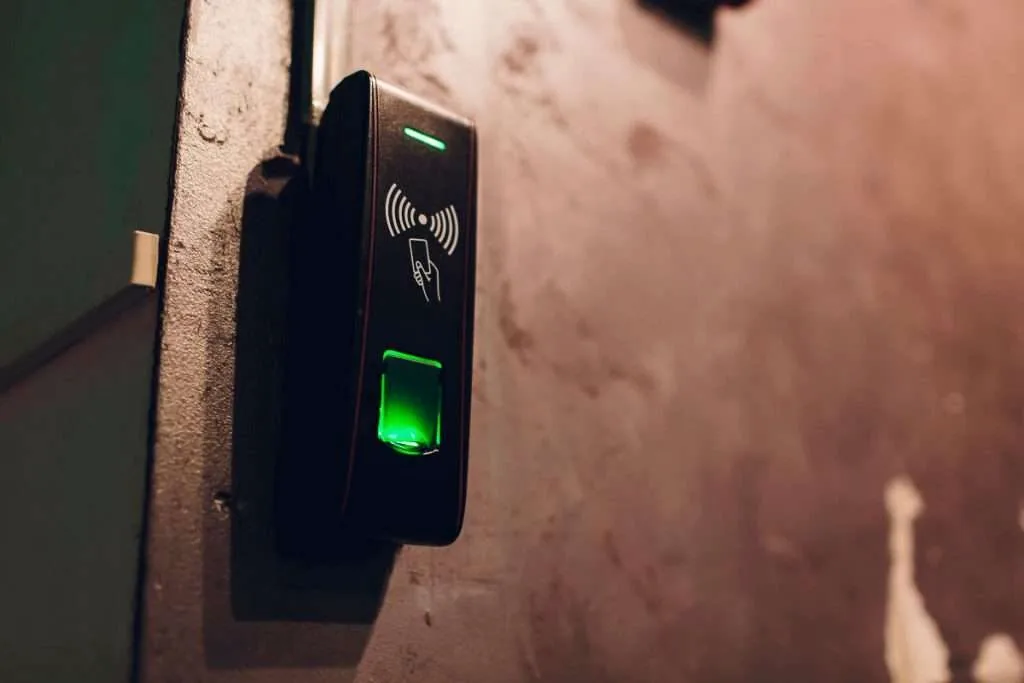
Locking devices
Electric strikes, magnetic locks and electrified locksets
These three are not interchangeable, and choosing between them is the decision with the most consequences on the whole job.
An electric strike replaces the fixed keeper in the frame with one that pivots away on a signal. The door's own latch still does the securing, so the mechanical lock stays in place and the key override survives. It is the least disruptive option on an existing door and usually the first thing to consider.
A magnetic lock has no latch. An electromagnet on the frame holds a steel plate on the door, and the door is secure only while it is powered. That makes it inherently fail-safe: cut the power and the door opens. It also means magnetic locks carry specific requirements for release devices and egress provision, because the building's security depends entirely on an electrical circuit.
An electrified lockset puts the electric release inside the lock body on the door itself. It gives the cleanest result on doors where the frame cannot be modified, at the cost of getting power across the hinge gap — usually through an electric hinge or a door loop.
Which one suits an opening depends on the existing lock, the frame, the fire rating, the egress path and how the door should behave when power fails. That is why the specification follows a look at the actual door rather than a catalogue choice.
Credentials
Credential types compared
Most sites end up mixing these by door rather than standardising on one. The question is which trade-off matters at each opening.
| Credential | Strengths | Trade-offs |
|---|---|---|
| PIN code | No hardware to issue; changed at the door in seconds | Gets shared and then rarely changed; no way to tell who used it |
| Proximity card | Quick to issue and revoke; cheap per user | Lost, lent and left in pockets; older formats are easy to clone |
| Key fob | Same as a card but harder to mislay on a keyring | Same sharing and cloning considerations |
| Mobile credential | No physical issue; suits high turnover; hard to lend casually | Depends on a phone, its battery and usually a network |
| Biometric | Nothing to lose, lend or copy | Enrolment effort, privacy and data-handling obligations, environmental sensitivity |
| Mechanical key override | Works with no power, no network and no administration | Changing access means physical work on cylinders |
Credential security varies widely within each category, particularly between older and newer card formats. The specific product matters as much as the type.
Constraints
Egress, fire ratings and what cannot be done
Access control is the area of locksmith work where regulation constrains the design most directly, and where the constraints are not negotiable.
The central principle is simple: people must be able to get out. A door serving as a required exit must permit egress from the inside without a key, a code, a credential or any special knowledge. No access-control arrangement may interfere with that, however convenient it would be. This is why request-to-exit provision is part of the design rather than an accessory.
Magnetic locks draw particular attention because the door has no independent latch. Their release arrangements, and their behaviour on loss of power or fire alarm, are specified for that reason.
Fire-rated door assemblies add another layer. These are tested and listed as complete assemblies — door, frame, hardware, seals — and modifying one can invalidate its rating. Drilling a fire door for a reader cable is not a small decision. Work on these openings generally requires listed components and may need the involvement of the authority having jurisdiction.
Where a proposed arrangement runs into one of these limits, we will say so and explain what can be done instead. Fitting it anyway is not an option we offer.
Process
How a system is specified
An access-control job goes wrong when it starts from a product. This is the order that avoids that.
Survey the doors
Each opening in scope: existing lock, frame type, fire rating, traffic, egress role and whether power can reach it.
Map the access
Who needs which doors, at which times, and how often that list changes. This determines the credential type as much as the hardware.
Decide the failure behaviour
What each door should do when power, network or controller is lost. Made deliberately, per door, and documented.
Install and hand over
Hardware fitted and tested under real conditions, credentials enrolled, and whoever administers the system shown how to add and remove people.
Troubleshooting
Common access-control faults
Reader accepts the card, door stays locked
Test in order: reader indication, controller log, relay operation, strike or magnet release, then whether the door is binding.
Intermittent failures at one door
Frequently power or cabling rather than the reader. Voltage drop over a long run is a classic cause.
Door unlocks but will not open
The electronics are working and the mechanics are not. Usually alignment or a latch fouling the strike.
Credentials that should have been revoked still work
An administration problem, not a hardware one. Worth auditing the list rather than the equipment.
Door held open without anyone noticing
No door-position monitoring. A cheap addition that turns guesswork into a log entry.
System unusable after a power cut
Battery backup missing or exhausted, or no documented mechanical override on any entrance.
Common questions
Access control questions
Discuss an access-control project
Tell us how many doors are involved, what kind of building, and roughly how many people need access.
Identification is required
For any work that provides access to a property, vehicle or safe, the technician will ask for photo identification and evidence that you are entitled to enter. Having that ready keeps the visit short.