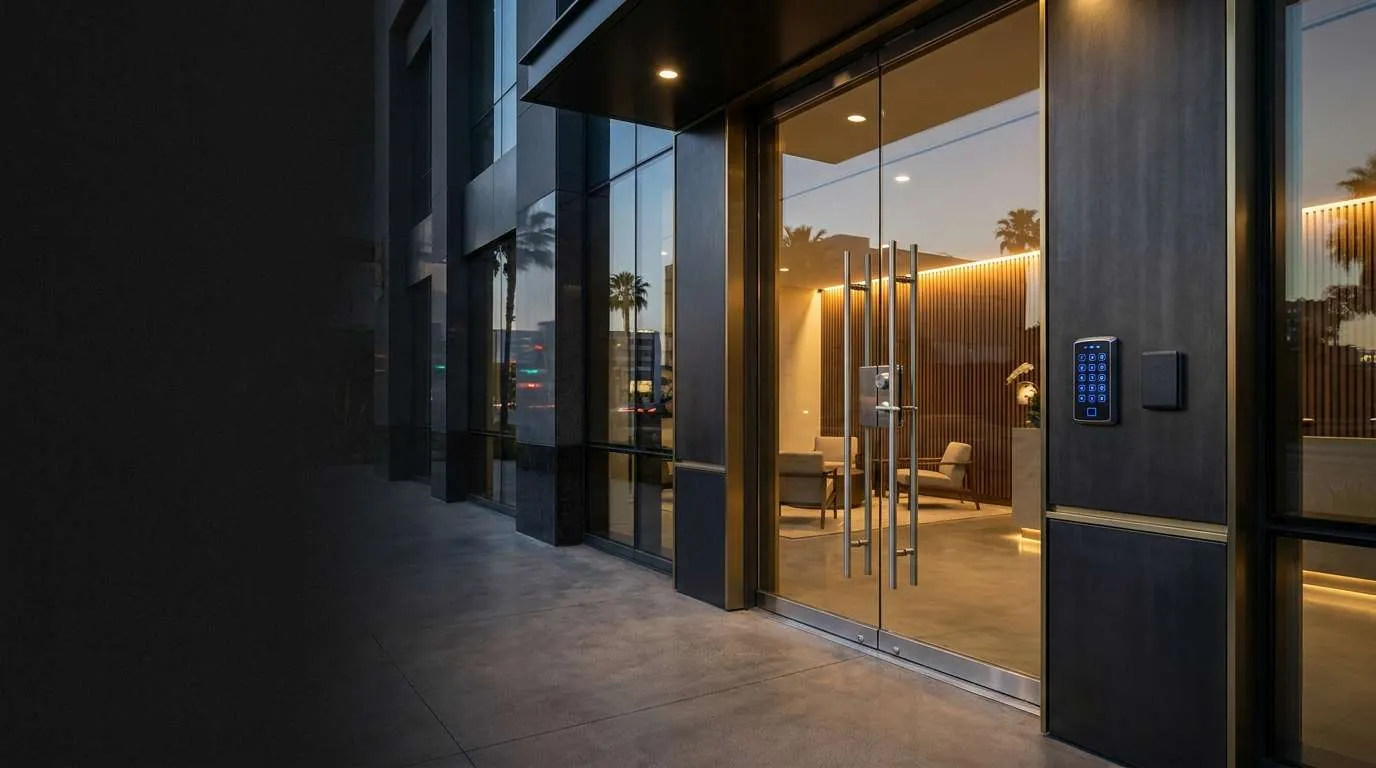
Commercial Locksmith Services
Storefront and office door hardware, master-key planning, panic bars, closers and commercial rekeying.

Service area
The Valley's civic and industrial centre, with the widest mix of property types anywhere in the service area.
Van Nuys locksmith
Van Nuys covers a lot of ground and does a lot of jobs. It holds the Valley's civic centre — courts, government offices and the municipal complex around Sylmar Avenue — alongside a substantial industrial district, a major airport, long commercial corridors on Van Nuys and Sepulveda Boulevards, and large residential neighbourhoods on either side.
That range is unusual. Within a few miles there are warehouses with roll-up doors and personnel entrances, older single-family streets, dense apartment blocks, auto dealerships and repair shops, retail parades, and offices of every size. Almost every category of locksmith work is represented somewhere in it.
The practical consequence is that a Van Nuys enquiry needs more identifying information than most: what kind of premises, what kind of door, and who has authority over it. A companion page covering the three main service lines is at locksmith services in Van Nuys.
Local context
The industrial areas, concentrated toward the airport and along the rail corridor, bring heavier hardware: roll-up doors, steel personnel doors, exit devices, yard gates and perimeter fencing. These openings take weather and abuse, and the specification has to reflect that rather than borrowing from commercial retail.
The residential streets are mostly post-war, with a high proportion of rental housing and a mix of single-family homes and apartment buildings. Turnover-driven rekeying is a constant, and multi-unit buildings benefit from compatible cylinders across the site.
The boulevards carry a long, varied commercial strip: small retail, restaurants, service businesses and offices. Alongside them sits a notable concentration of automotive businesses, which is one reason vehicle key work features heavily in this part of the Valley.
On the ground
What a technician meets in Van Nuys depends heavily on which part of the area the property is in.
Roll-up doors, steel personnel doors, exit devices and yard gates. Heavy use, exposure and a stronger case for door-position monitoring than most premises.
Apartment buildings with shared entrances and individual units. Compatible cylinders across a building make turnover rekeying considerably faster.
Dealerships, repair shops and a great deal of street and lot parking, which makes vehicle key and lockout work frequent here.
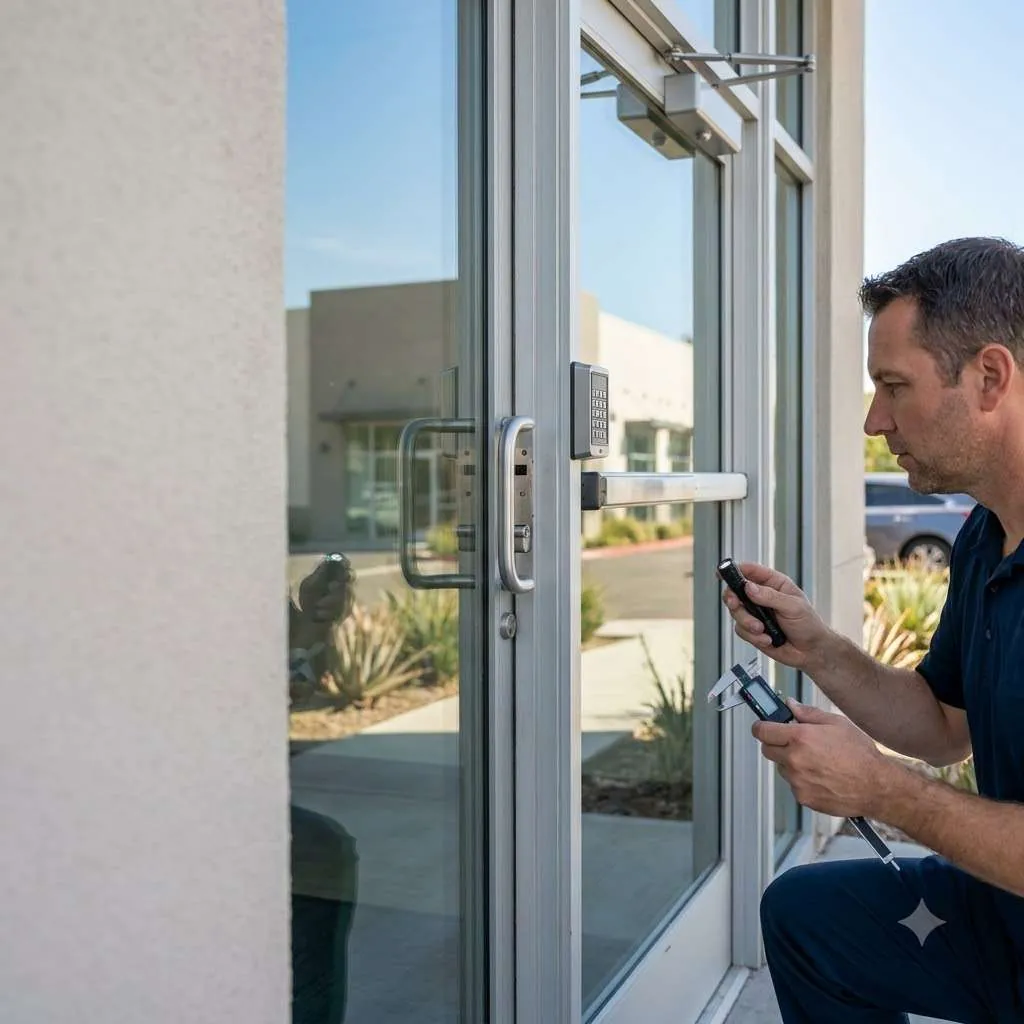
Long commercial strips with small units, glass frontages and the usual narrow-stile hardware and closer wear.
Government and professional buildings where authorisation for work is formal and needs establishing before anything is scheduled.
In practice
A door on a warehouse is not a shop door in a tougher finish. It faces different loads, different weather and different use, and specifying it as though it were commercial retail is the usual reason hardware fails early.
Personnel doors beside roll-up openings are the clearest example. They are steel, they are heavy, they are often in full sun on one face and shade on the other, and they get kicked, propped and slammed by people carrying things. Closers on these doors work harder than anywhere else, and a closer that has lost its adjustment leaves the door either slamming hard enough to damage the frame or not closing far enough for the latch to engage.
Exit devices matter here too, and not only for compliance. A panic bar on a warehouse door takes repeated impact from people leaving with full hands. When one stops latching, the building is unsecured overnight and nobody notices until morning. Door-position monitoring — a cheap switch that reports whether the door is actually closed — is worth more on these openings than almost anywhere else.
Yard gates and perimeter access complete the picture. Gate hardware takes weather and movement, and a gate that has dropped will stop latching long before anyone calls it a fault.
Common calls
A sample of the calls that come from this part of the service area.
Usually the closer rather than the lock. On a heavy steel door in full sun, closers lose adjustment quickly.
The building is unsecured overnight and nobody notices until morning. Worth pairing with a door-position switch.
A compatible keyway across the building turns a sequence of visits into a single efficient round.
Non-destructive entry where the vehicle allows it, after ownership has been confirmed.
Gate hardware takes weather and movement; a sagging gate stops latching long before it looks broken.
A named tenant for the unit itself; the building owner or agent for shared entrances and common areas.
Services
Each service page explains the work in full. The order below reflects what comes up most often in this part of the service area.
Storefront and office door hardware, master-key planning, panic bars, closers and commercial rekeying.
Rekeying, lock repair and replacement, smart locks and authorised house lockouts for homes, condominiums and rental property.
Car key replacement, transponder and fob programming, ignition work and authorised vehicle lockouts.
Assistance when a door, vehicle or safe cannot be opened, or when a lock has failed and the opening needs securing.
Readers, controllers, electric strikes and magnetic locks for buildings that manage entry with credentials rather than keys.
Camera placement, cabling, recorder setup and remote viewing for homes, offices and multi-unit property.
Process
The property or vehicle, the hardware involved and what changed. Photographs of the lock face and door edge help.
We confirm which service line applies and what the technician needs to bring, including how authorisation will be shown.
The hardware and the whole opening are inspected before anything is replaced.
Locks, keys or credentials are tested in place before the visit ends.
Coverage
Neighbouring communities with their own pages. Each describes the property types and lock work common to that area.
Common questions
Tell us the address or neighbourhood, the hardware involved and what it is doing.
For any work that provides access to a property, vehicle or safe, the technician will ask for photo identification and evidence that you are entitled to enter. Having that ready keeps the visit short.