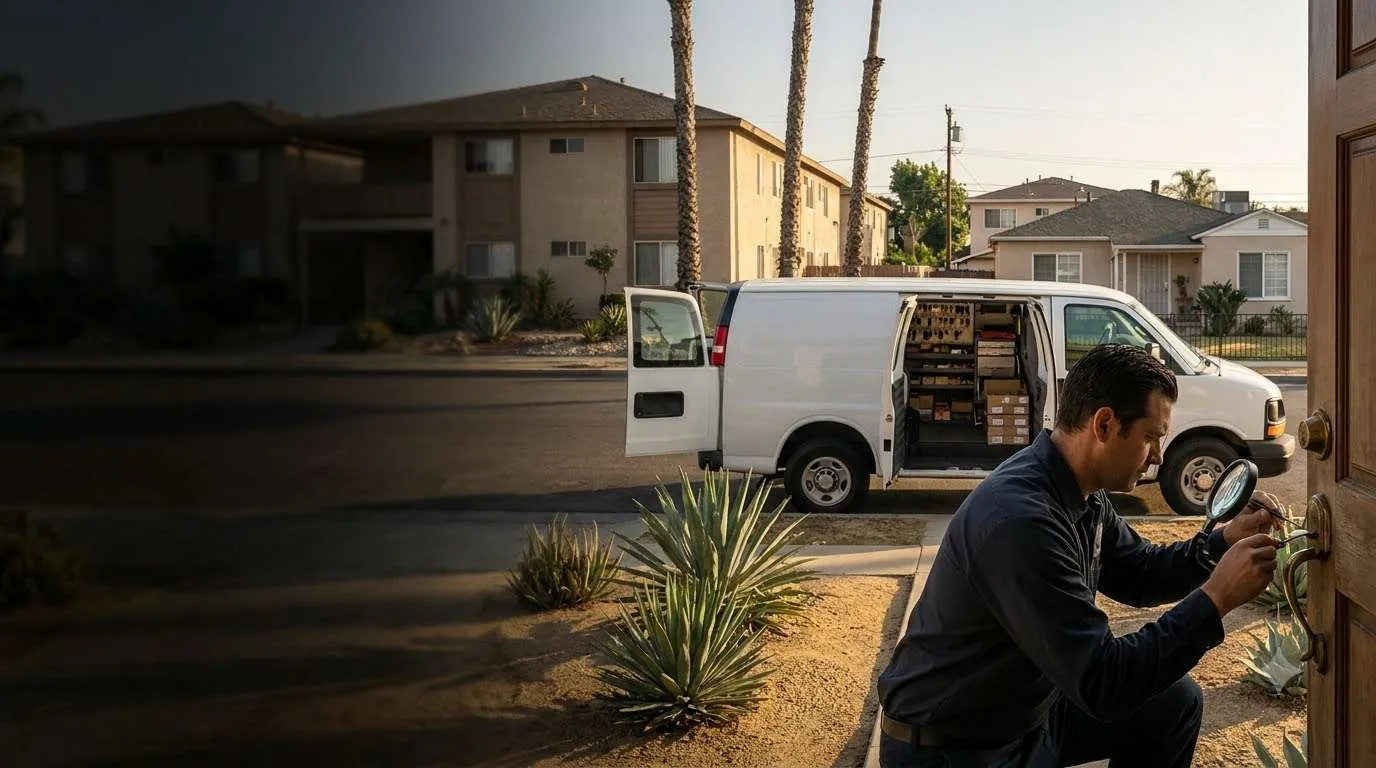
Residential Locksmith Services
Rekeying, lock repair and replacement, smart locks and authorised house lockouts for homes, condominiums and rental property.

Service area
One of the Valley's original planned post-war communities, now with a dense mix of apartments, houses and commercial frontage.
Panorama City locksmith
Panorama City was built as a planned community in the years immediately after the Second World War — one of the first large-scale developments of its kind in the Valley. The original street pattern and much of the original housing are still in place, which gives the area an unusually consistent architectural baseline.
Since then a substantial layer of apartment development has been added, particularly along the larger streets, so the housing mix now runs from original single-family homes to mid-century and later multi-unit blocks. Van Nuys Boulevard provides the commercial spine, with retail, service businesses and medical premises along it.
The practical effect for lock work is a high proportion of multi-unit residential jobs — turnover rekeying, shared-entrance hardware and mailbox locks — sitting alongside the ordinary business of post-war house doors that have been moving for seventy years.
Local context
The original houses were built to a small number of repeated plans, which has an unexpected benefit: door preparations across the neighbourhood are unusually consistent. Standard backsets and bore sizes mean replacement hardware fits without modification far more often than in an area of mixed housing.
The apartment buildings are the other half of the picture, and they generate the majority of the local work. Turnover rekeying is constant, shared entrances take heavy use, and mailbox locks — particularly on cluster units — come up far more often than most people would expect.
Along Van Nuys Boulevard the commercial stock is varied: retail units, service businesses, medical and dental premises. These are mostly small-format with glass frontages, though the medical premises bring their own requirements around records rooms and restricted areas.
On the ground
What a technician meets in Panorama City depends heavily on which part of the area the property is in.
Shared entrances, individual units and cluster mailboxes. Turnover rekeying is the steady background work of the area.
Built to repeated plans, which makes door preparations unusually consistent and replacement hardware easier to fit.
A frequent and frequently overlooked job, particularly after a move when the previous key was never handed over.
Retail, service and medical premises with glass frontages and, in the medical case, restricted internal areas.
Dense parking along the boulevard and around the apartment blocks, where vehicle lockout calls originate.
In practice
Where a large share of the housing is multi-unit, the single most useful thing an owner can do is stop treating each door as a separate problem.
The typical unplanned building has accumulated its keying by accident. A cylinder was replaced here in 2011, another there in 2016, each with whatever was on the van that day. The result is a building where no two units share a keyway, the owner carries a ring of a dozen keys, and every turnover means starting from scratch on that specific door.
Standardising the keyway fixes this permanently. Every cylinder in the building becomes interchangeable, so re-pinning is quick and stock is simple. The owner or manager can hold one master key that opens every unit, while each tenant's key opens only their own door. Turnover becomes a routine operation rather than an investigation.
A restricted keyway is worth considering at the same time. On a standard keyway, any tenant can have a key copied at a hardware counter, and nothing in the building record will show it. On a restricted system, blanks are controlled and duplication requires authorisation — which means the key that comes back at the end of a tenancy is genuinely the only one.
Common areas deserve separate thought. Shared entrances, laundry rooms and mail areas take far more use than unit doors, and are usually better on their own key or, where turnover is high, on a credential system where access can be withdrawn without a site visit.
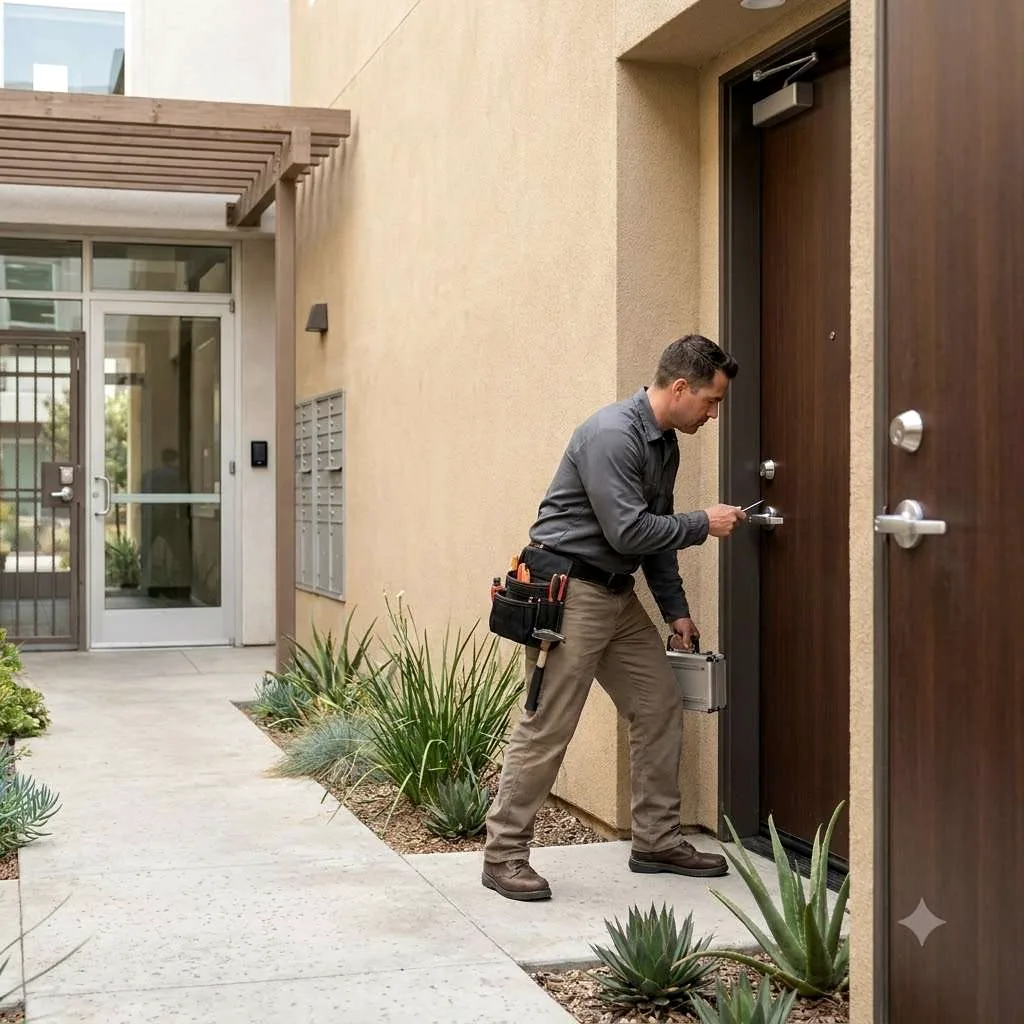
Common calls
A sample of the calls that come from this part of the service area.
One visit covering multiple doors, which is far quicker per unit than calling individually.
Common and easily resolved, though who owns the lock depends on the mailbox type.
Closers and latches wear fast on communal doors; the fault is usually mechanical rather than the cylinder.
Consistent door preparations across the neighbourhood make replacement hardware straightforward to fit.
Restricting entry is a compliance matter, and the records door should not share a key with the suite entrance.
Non-destructive entry after ownership is confirmed.
Services
Each service page explains the work in full. The order below reflects what comes up most often in this part of the service area.
Rekeying, lock repair and replacement, smart locks and authorised house lockouts for homes, condominiums and rental property.
Storefront and office door hardware, master-key planning, panic bars, closers and commercial rekeying.
Assistance when a door, vehicle or safe cannot be opened, or when a lock has failed and the opening needs securing.
Car key replacement, transponder and fob programming, ignition work and authorised vehicle lockouts.
Readers, controllers, electric strikes and magnetic locks for buildings that manage entry with credentials rather than keys.
Safe opening with proof of ownership, lock diagnostics, combination changes and installation planning.
Process
The property or vehicle, the hardware involved and what changed. Photographs of the lock face and door edge help.
We confirm which service line applies and what the technician needs to bring, including how authorisation will be shown.
The hardware and the whole opening are inspected before anything is replaced.
Locks, keys or credentials are tested in place before the visit ends.
Coverage
Neighbouring communities with their own pages. Each describes the property types and lock work common to that area.
Common questions
Tell us the address or neighbourhood, the hardware involved and what it is doing.
For any work that provides access to a property, vehicle or safe, the technician will ask for photo identification and evidence that you are entitled to enter. Having that ready keeps the visit short.