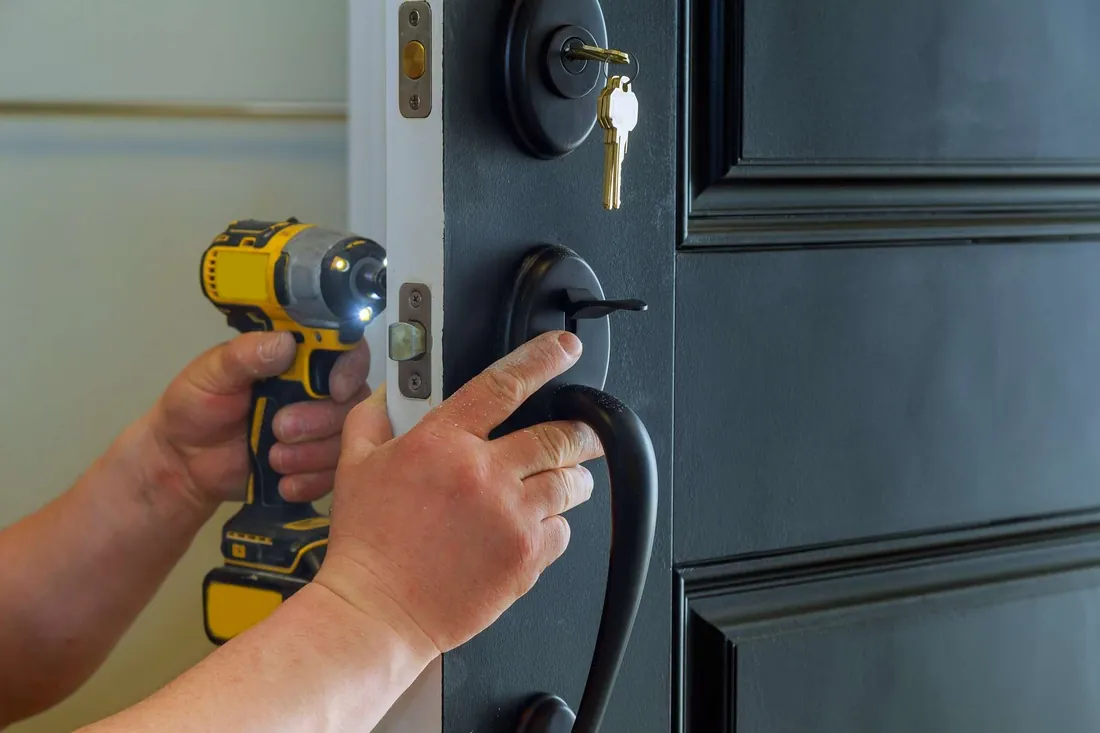
Residential Locksmith Services
Rekeying, lock repair and replacement, smart locks and authorised house lockouts for homes, condominiums and rental property.

Service area
A quiet residential pocket between North Hollywood and Studio City, with a housing stock older than much of the surrounding Valley.
Valley Village locksmith
Valley Village is small, largely residential and noticeably older in character than the neighbourhoods around it. Much of it was laid out before the post-war building boom, and the streets between Magnolia and Riverside still carry a concentration of nineteen-thirties and nineteen-forties houses — Spanish revival, traditional and early ranch — on modest lots with mature trees.
That age profile has direct consequences for lock work. Original mortise locks are still in service on a good number of front doors. Timber has moved over eighty years. Frames have settled. Hardware that was perfectly specified in 1938 is now working against a door that has changed shape around it.
Alongside the houses sits a substantial stock of duplexes, fourplexes and small apartment buildings, which adds a steady rhythm of tenancy-change rekeying. A companion page covering the three main service lines is at locksmith services in Valley Village.
Local context
Pre-war and early post-war construction dominates the residential streets, and with it comes hardware that a newer neighbourhood simply does not have: mortise lock bodies set into the door edge, skeleton-key interior locks, original rim cylinders and decorative escutcheons that owners often want to keep.
Mortise locks are worth treating differently from modern cylindrical hardware. They were built to be serviced rather than thrown away, and a lock body that has become stiff or unreliable can frequently be stripped, cleaned and rebuilt. Replacing one with a modern unit usually means enlarging or patching the mortise pocket, which is destructive and rarely necessary.
The small multi-unit buildings scattered through the area — duplexes, fourplexes and courtyard blocks — are the other half of the picture. They turn over regularly, and because they are small they often have no standardised keying at all, with every unit on a different keyway.
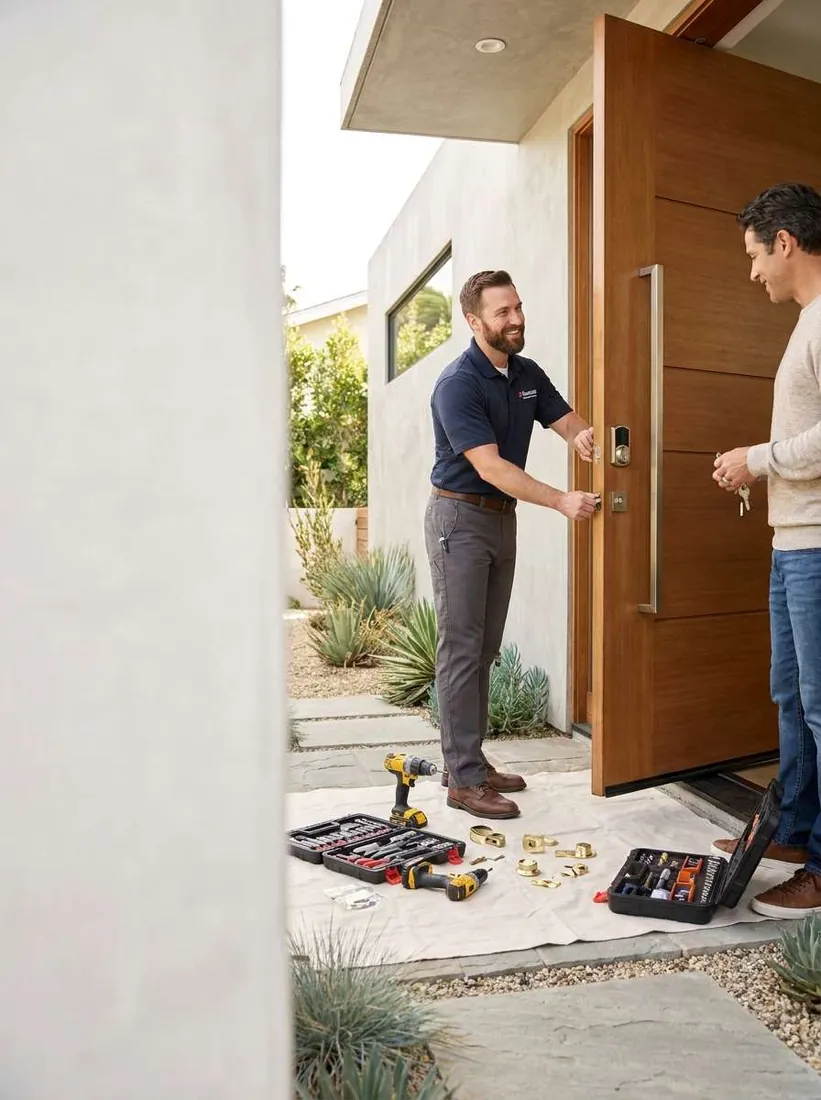
In practice
The temptation with an old, stiff mortise lock is to take it out and fit something modern. That is usually the wrong call, and it is worth understanding why.
A mortise lock sits in a rectangular pocket cut into the edge of the door. The pocket was machined for that specific lock body. Modern cylindrical hardware needs a round bore instead, so converting means filling the pocket, re-boring the door, and patching the face where the old escutcheon sat. On a solid-timber period door, that is a destructive and visible change.
The alternative is generally straightforward. Mortise locks were designed to be serviced: the case comes off, the mechanism is cleaned of eighty years of hardened grease and dust, worn springs are replaced, the follower and levers are checked, and the whole thing goes back together working properly. Replacement cylinders are widely available for the common patterns, so key control can be updated without touching the lock body.
Where a period door genuinely needs better security — and many do, because a beautiful lock is not necessarily a strong one — the usual answer is to add rather than replace. A modern deadbolt fitted above the original, or a reinforced strike with long screws into the stud, improves the opening substantially while leaving the historic hardware exactly where it is.
Services
Each service page explains the work in full. The order below reflects what comes up most often in this part of the service area.
Rekeying, lock repair and replacement, smart locks and authorised house lockouts for homes, condominiums and rental property.
Assistance when a door, vehicle or safe cannot be opened, or when a lock has failed and the opening needs securing.
Car key replacement, transponder and fob programming, ignition work and authorised vehicle lockouts.
Storefront and office door hardware, master-key planning, panic bars, closers and commercial rekeying.
Safe opening with proof of ownership, lock diagnostics, combination changes and installation planning.
Camera placement, cabling, recorder setup and remote viewing for homes, offices and multi-unit property.
Common calls
A sample of the calls that come from this part of the service area.
Usually a candidate for stripping and rebuilding rather than replacement, which would mean cutting the door.
Modern security can often be added behind or alongside original furniture rather than instead of it.
Standardising the keyway makes every future turnover faster and lets the owner hold one master.
Replacements for these are usually obtainable, and the lock itself rarely needs changing.
Short work on a single cylinder, and best scheduled in the gap between occupants.
Timber movement rather than lock failure. Hinge and strike adjustment normally resolves it.
On the ground
What a technician meets in Valley Village depends heavily on which part of the area the property is in.
Original lock bodies set into the door edge, often still serviceable. Rebuilding beats replacing, both for cost and because replacement means cutting the door.
The later streets carry more conventional cylindrical hardware, with the usual pattern of doors that have dropped and strikes that no longer line up.
Small multi-unit buildings with frequent turnover and, very often, no consistent keying across the units.
Skeleton-key interior doors, original escutcheons and period furniture that owners generally want preserved rather than modernised.
Mostly on-street parking under mature trees, which is where vehicle key and lockout calls tend to originate.
Process
The property or vehicle, the hardware involved and what changed. Photographs of the lock face and door edge help.
We confirm which service line applies and what the technician needs to bring, including how authorisation will be shown.
The hardware and the whole opening are inspected before anything is replaced.
Locks, keys or credentials are tested in place before the visit ends.
Coverage
Neighbouring communities with their own pages. Each describes the property types and lock work common to that area.
Common questions
Tell us the address or neighbourhood, the hardware involved and what it is doing.
For any work that provides access to a property, vehicle or safe, the technician will ask for photo identification and evidence that you are entitled to enter. Having that ready keeps the visit short.