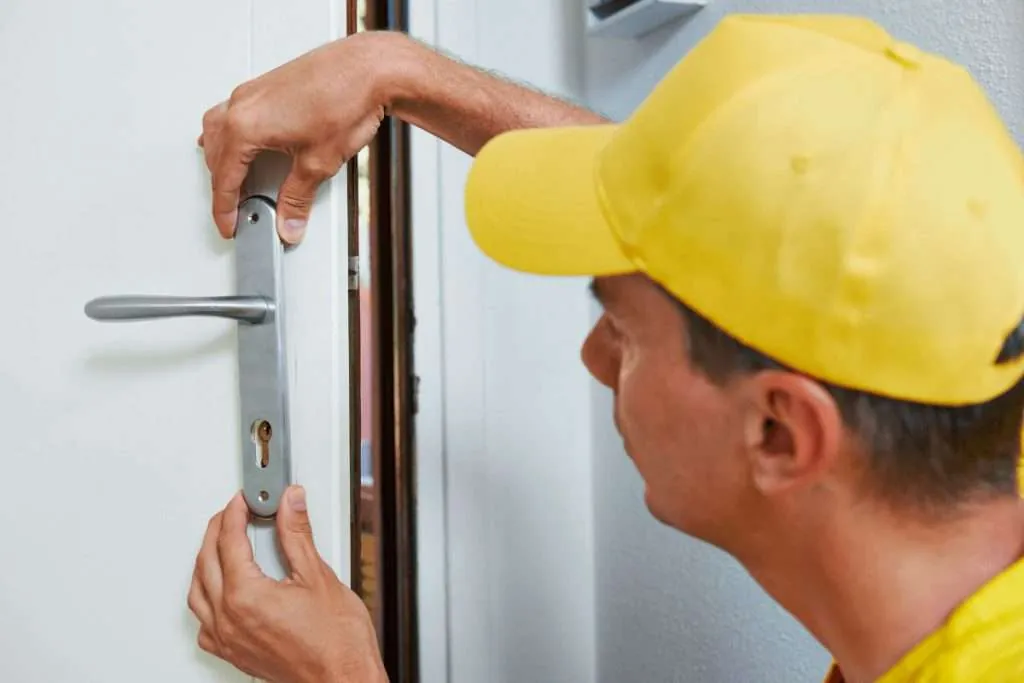
Residential Locksmith Services
Rekeying, lock repair and replacement, smart locks and authorised house lockouts for homes, condominiums and rental property.

Service area
The largest of the Conejo Valley communities, spread across a wide area with extensive open space woven through it.
Thousand Oaks locksmith
Thousand Oaks is the biggest city in the Conejo Valley and the furthest point west in the published service area. It covers a large area, and one of its defining features is how much open space runs through and around it: preserved hillsides, canyons and trail corridors separate neighbourhoods from one another rather than surrounding a single built core.
The housing is largely suburban and mostly from the nineteen-sixties onward, with later development on the outer edges. Properties along the open-space boundaries are frequently larger, with more exterior access and grounds running up to protected land.
Commercially, the city has office and business premises spread along its main corridors, with retail centres serving the surrounding neighbourhoods. As the furthest point in the service area, scheduling here benefits from a little more notice than a job in the central Valley.
Local context
The housing stock is later than most of the service area, which has the usual practical consequences: standardised door preparations, sound frames, and hardware upgrades that fit without modification. Two-storey homes are common, and heavier front doors accelerate hinge wear in a way that matters for motorised locks.
What is distinctive is the amount of property that adjoins open space. Where a rear boundary backs onto a preserved hillside or a canyon, it is not overlooked by neighbouring houses, and the rear of the property becomes the part worth attention rather than the street elevation.
Being at the far end of the service area, jobs here are better planned than improvised. For anything that can be anticipated — a rekey after a purchase, a hardware upgrade, a gate installation — arranging it in advance produces a much better result than calling at short notice.
In practice
In a conventional street, the rear of a house is protected as much by neighbours as by hardware. Fences are shared, windows overlook gardens, and anyone spending time at the back of a property is visible from several directions.
Where a boundary backs onto preserved open space, none of that applies. There is no neighbouring window, no shared fence line, and nobody with a reason to be looking. Someone at the rear of the property is effectively unobserved, and they can take as long as they like.
That changes where effort is worth spending. The street elevation of most houses here is already the well-defended side: a solid front door, a decent deadbolt, and the deterrent of being visible from the road. The rear commonly has a lighter door, a sliding panel, a side gate with a domestic latch and no lighting at all.
Four things address most of it. The rear door should be brought to the same standard as the front, including a reinforced strike with screws that reach the " framing. Sliding doors need a secondary bolt and a measure to stop the panel being " lifted from its track. The side gate needs exterior-rated hardware fitted to a gate " that actually closes square. And a camera positioned where somebody has to pass " — at the gate or on the path — produces something identifiable in a way " that a camera surveying open hillside never will.
None of this is expensive individually. The reason it so often goes undone is simply that the back of a house is the part nobody looks at.
Services
Each service page explains the work in full. The order below reflects what comes up most often in this part of the service area.
Rekeying, lock repair and replacement, smart locks and authorised house lockouts for homes, condominiums and rental property.
Camera placement, cabling, recorder setup and remote viewing for homes, offices and multi-unit property.
Readers, controllers, electric strikes and magnetic locks for buildings that manage entry with credentials rather than keys.
Storefront and office door hardware, master-key planning, panic bars, closers and commercial rekeying.
Assistance when a door, vehicle or safe cannot be opened, or when a lock has failed and the opening needs securing.
Car key replacement, transponder and fob programming, ignition work and authorised vehicle lockouts.
Common calls
A sample of the calls that come from this part of the service area.
Rear access and camera placement matter more than the street elevation.
Weight accelerates hinge wear; a dropped door exhausts a motor.
Better scheduled than improvised, given the distance from the central Valley.
Gate hardware rated for exterior use and tolerant of movement.
Conventional commercial hardware and the usual closer and alignment work.
Secondary bolt and anti-lift measures, particularly where the rear is unobserved.
On the ground
What a technician meets in Thousand Oaks depends heavily on which part of the area the property is in.
Later construction with standardised preparations and generally sound frames, where upgrades fit directly.
Rear boundaries backing onto preserved land, unobserved by neighbours, where cameras and gates earn their place.
Gates, side access and outbuildings on the outer edges of the city.
Offices, business units and retail centres spread along the main routes rather than concentrated in one core.
Heavier doors accelerate hinge wear, which matters most where a motorised lock is fitted.
Process
The property or vehicle, the hardware involved and what changed. Photographs of the lock face and door edge help.
We confirm which service line applies and what the technician needs to bring, including how authorisation will be shown.
The hardware and the whole opening are inspected before anything is replaced.
Locks, keys or credentials are tested in place before the visit ends.
Coverage
Neighbouring communities with their own pages. Each describes the property types and lock work common to that area.
Common questions
Tell us the address or neighbourhood, the hardware involved and what it is doing.
For any work that provides access to a property, vehicle or safe, the technician will ask for photo identification and evidence that you are entitled to enter. Having that ready keeps the visit short.