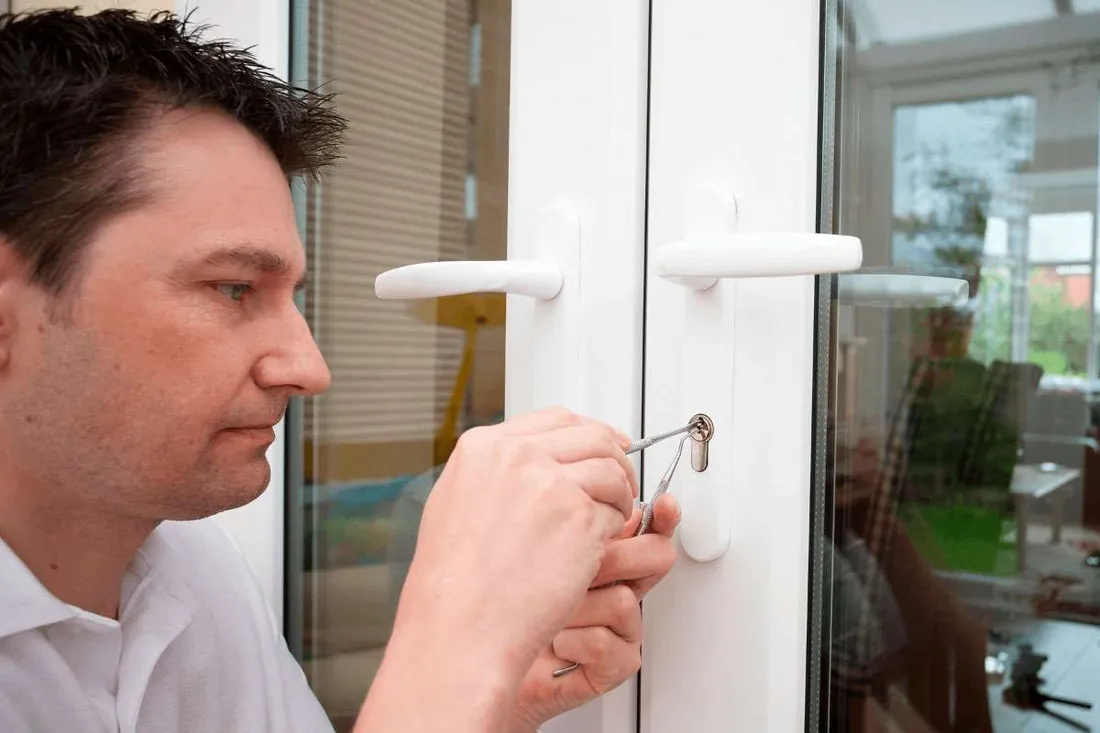
Commercial Locksmith Services
Storefront and office door hardware, master-key planning, panic bars, closers and commercial rekeying.

Service area
The Valley's north-western corner, where a large business and industrial district sits below rocky hillsides and horse properties.
Chatsworth locksmith
Chatsworth is unusual in the Valley for how much of it is commercial. A substantial business and light-industrial district occupies the flat ground toward the north and west, with business parks, warehousing, manufacturing and office premises spread across a large area.
Above and beyond that, the land rises into the sandstone formations of the Santa Susana Mountains. The residential streets closer to the hills include equestrian properties, large lots and houses with detached structures and substantial grounds — a legacy of the area's ranching history that has not entirely disappeared.
The suburban middle is conventional: post-war and later single-family housing on regular streets. But it is the commercial and semi-rural extremes that give the area its distinctive pattern of work.
On the ground
What a technician meets in Chatsworth depends heavily on which part of the area the property is in.
Roll-up doors, steel personnel entrances, exit devices and loading access. Heavy duty hardware is not optional here.
Multiple tenants sharing gated yards, loading and parking, which makes establishing who authorises work the first step.
Stables, tack rooms, feed stores and workshops spread across substantial grounds, exposed to dust and weather.
Long boundaries with vehicle and pedestrian access, usually better handled with codes than with keys.
Conventional post-war and later housing across the middle of the area, with standard rekeying and repair work.
Common calls
A sample of the calls that come from this part of the service area.
Closer adjustment under heavy load, not a failing cylinder.
Authorisation sits with park management rather than any one tenant.
Dust and weather seize open shackles; a shrouded exterior body lasts far longer.
Securing the opening first, then replacing damaged hardware with a proper specification.
A tiered key plan rather than one key that opens everything.
Rekeying the cylinders that person held, or revoking credentials where a system exists.
In practice
The single most common reason commercial hardware fails early in this part of the Valley is that it was specified for the wrong environment.
An industrial personnel door is not an office door in a different colour. It is steel, it is heavy, it is often in full sun on one face and shade on the other, and it is used by people carrying things who push it with a shoulder rather than turning a handle. Cycle counts are high and the loads are sudden.
Three components carry most of that stress. The closer works hardest: a heavy door needs a correctly sized closer, adjusted for both closing and latching speed, and when it drifts out of adjustment the door either slams hard enough to damage the frame or fails to close far enough for the latch to catch. The exit device takes repeated impact, and a panic bar that stops latching leaves premises open overnight. And the cylinder faces dust, which turns lubricant into an abrasive paste.
Getting the specification right is not expensive relative to the cost of replacing failed hardware twice. Commercial-grade lock bodies, correctly sized closers, exterior-rated cylinders and exit devices matched to the door and frame all cost more initially and considerably less over five years.
One inexpensive addition is worth specific mention: a door-position switch. On a loading door or a rear personnel door, knowing that the door is actually closed — rather than propped, or latched incompletely — is worth more than almost any upgrade to the lock itself.
Local context
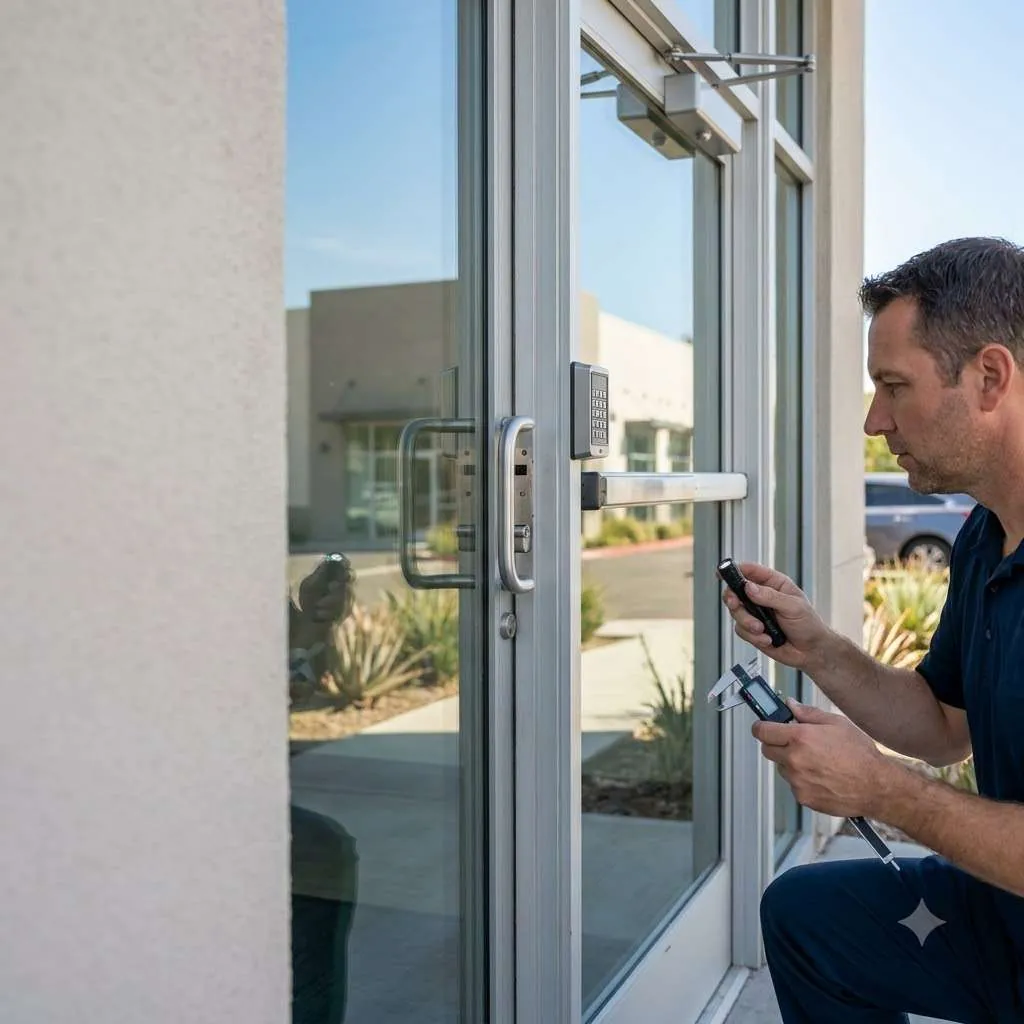
The industrial and business-park stock brings the heaviest hardware in the service area: steel personnel doors beside roll-up openings, exit devices under constant load, yard gates, perimeter fencing and loading-dock access. These are openings where specification matters, because residential-grade hardware fails within months.
Business parks in particular tend to have multiple tenants sharing common access — a gated yard, shared loading, shared parking — which means authorisation for work has to be established carefully. A tenant can authorise work on their own unit; shared access belongs to the park's management.
The hillside and equestrian properties present the opposite challenge: buildings spread over a large area, exposed to dust and weather, with outbuildings that hold genuinely valuable equipment and are frequently secured with whatever was cheapest at the time.
Services
Each service page explains the work in full. The order below reflects what comes up most often in this part of the service area.
Storefront and office door hardware, master-key planning, panic bars, closers and commercial rekeying.
Readers, controllers, electric strikes and magnetic locks for buildings that manage entry with credentials rather than keys.
Rekeying, lock repair and replacement, smart locks and authorised house lockouts for homes, condominiums and rental property.
Camera placement, cabling, recorder setup and remote viewing for homes, offices and multi-unit property.
Assistance when a door, vehicle or safe cannot be opened, or when a lock has failed and the opening needs securing.
Car key replacement, transponder and fob programming, ignition work and authorised vehicle lockouts.
Coverage
Neighbouring communities with their own pages. Each describes the property types and lock work common to that area.
Process
The property or vehicle, the hardware involved and what changed. Photographs of the lock face and door edge help.
We confirm which service line applies and what the technician needs to bring, including how authorisation will be shown.
The hardware and the whole opening are inspected before anything is replaced.
Locks, keys or credentials are tested in place before the visit ends.
Common questions
Tell us the address or neighbourhood, the hardware involved and what it is doing.
For any work that provides access to a property, vehicle or safe, the technician will ask for photo identification and evidence that you are entitled to enter. Having that ready keeps the visit short.