
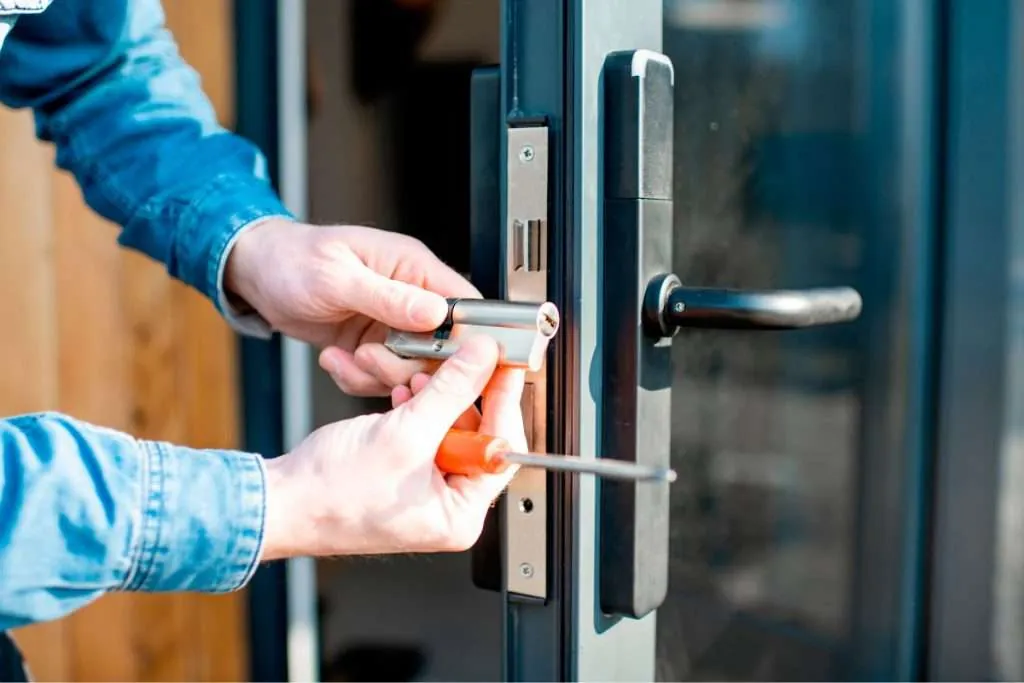
Commercial work in Beverly Hills
Commercial locksmith in Beverly Hills, CA
Professional office suites, retail premises and the internal rooms that usually need separating from the suite key.
Commercial work in Beverly Hills
Offices, retail, and a formal approach to authorisation
Commercial Beverly Hills divides into two broad groups. The first is the dense concentration of professional offices — legal, financial, medical and entertainment — in mid-rise buildings through the flats. The second is the retail district, where high-value stock sits behind large areas of glass.
Both share a characteristic that shapes how work is arranged: management is formal. Buildings have managing agents, suites have office managers, and retail premises frequently answer to a regional or corporate structure. Establishing who can authorise work is a genuine first step rather than a courtesy.
The technical work is conventional commercial locksmithing. What is less conventional, and more consistently useful here, is the question of what happens inside a suite once someone has passed the front door.
Common cases
Common commercial calls here
A file or records room on the suite key
The most common internal weakness, and often a compliance matter rather than a preference.
Staff leaving a practice
Targeted rekeying, or credential revocation where a system exists.
A managing agent arranging building work
Clear authorisation, provided it is established before the visit.
Retail premises with stock behind glass
Rear and service doors usually matter more than the frontage.
A suite changing tenants
Rekeying before occupation, coordinated with building management.
A safe in an office with no combination record
Opening with proof of ownership, then a fresh combination recorded off-site.
In detail
The room behind the suite door
In a well-run building the outer layers of access are handled properly: a lobby with a desk, credentials issued and revoked through a defined process, lift access controlled by floor. The weak point is almost always inside a tenant suite.
The reason is understandable. A suite feels like one secure space because everyone who reaches it has already passed several checkpoints. So the file room, the server cupboard, the store holding equipment and the office containing the safe all end up on the same key as the suite entrance.
That means every person ever issued a suite key can open all of them — former employees, cleaners, contractors, whoever borrowed one for an afternoon — and nothing anywhere records that they did.
For a practice holding client files or patient material, that is not simply untidy. Confidentiality obligations generally require that access to those records be controlled, and “everyone with a suite key” is not a control.
The minimum fix is a separate key on those doors, held by fewer people, with a written record of who holds it. The better fix is a standalone credential lock on two or three specific doors, which adds the thing a key cannot: a log of who entered and when, and instant revocation when someone leaves.

Options
Options for controlling internal access
None of these requires a building-wide system. Two or three doors is a common and proportionate scope.
Separate key, fewer holders
The minimum change. Cheap, immediate, and a written record of who holds it.
Restricted keyway
Blanks controlled, duplication requires authorisation. Makes a returned key mean something.
Standalone credential lock
A single door with codes or cards, logged entry and instant revocation. No cabling to the rest of the building.
Networked access control
For several doors under one administration, with scheduling and central reporting.
Door-position monitoring
Reports whether a sensitive door is genuinely closed rather than propped.
Safe relocation or lock change
Where a safe is the actual control rather than the door.
Process
How the visit runs
Describe it
The property or vehicle, the hardware involved, and what changed before the problem started.
Confirm the service
We confirm what applies and what the technician needs to bring, including how authorisation will be shown.
Diagnose on site
The hardware and the whole opening are inspected before anything is replaced.
Complete and test
Everything is tested in place before the visit ends.
Before you call
What helps when you call
- Whether the doors are suite interior, suite entrance or building common area
- Who holds authority: tenant, office manager, or managing agent
- How many people currently hold a key to each door
- Whether any records held are subject to confidentiality obligations
- Whether a credential system already exists in the building
- Whether any door is a required exit
- Whether the lease restricts changes to the suite door
- A photograph of the door and its existing hardware
Common questions
Beverly Hills commercial questions
Request commercial locksmith work in Beverly Hills
Tell us which doors are involved and who holds authority over them.
Identification is required
For any work that provides access to a property, vehicle or safe, the technician will ask for photo identification and evidence that you are entitled to enter. Having that ready keeps the visit short.