
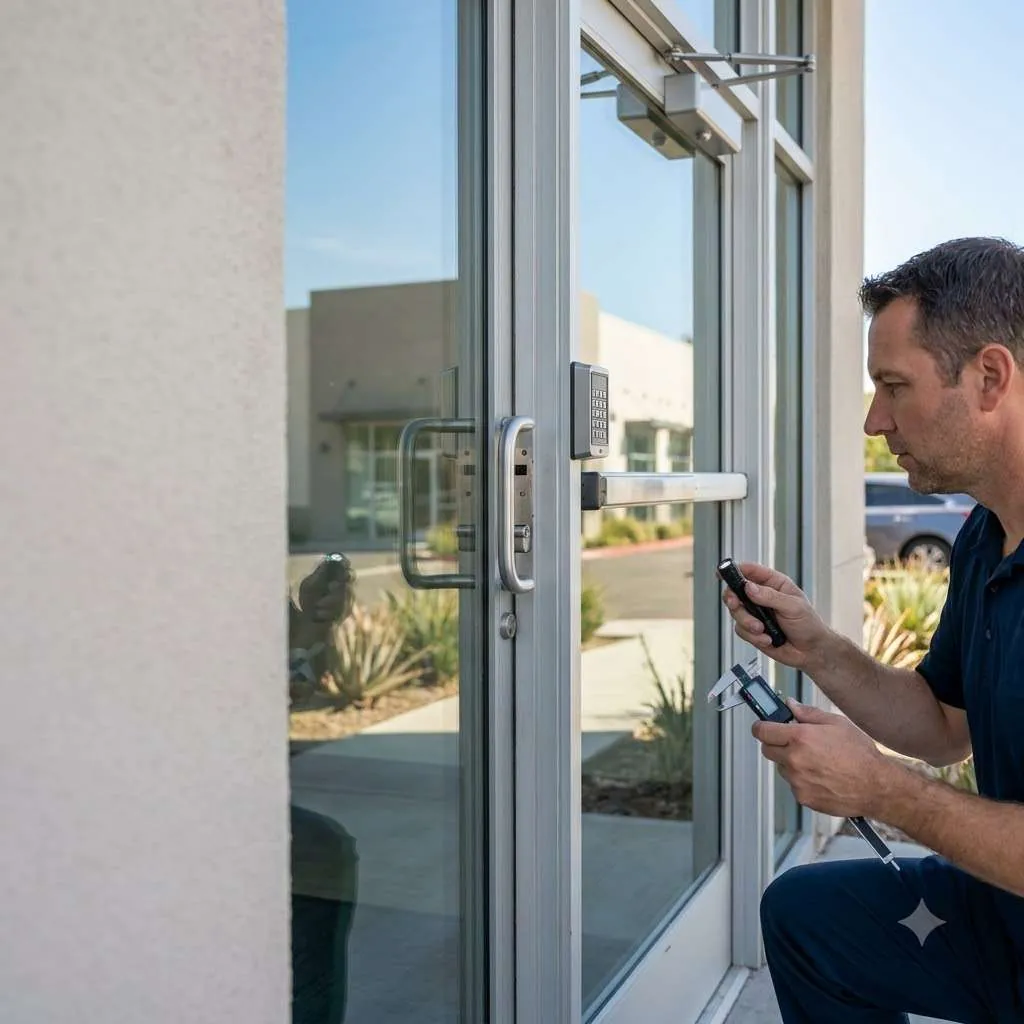
Commercial work in West Hollywood
Commercial locksmith in West Hollywood, CA
Showrooms, retail, restaurants and bars along some of the densest commercial frontage in the county — where the rear door usually matters more than the front.
Commercial work in West Hollywood
Continuous frontage, high cycle counts, late hours
Commercial West Hollywood is dense and close to continuous. Santa Monica Boulevard, Sunset, Melrose and the design district carry an almost unbroken run of retail, showrooms, restaurants, bars, salons and offices, most of them in small-format units with substantial glass frontage.
Three things follow from that. Doors cycle constantly, so closers and latches wear faster than the cylinders they are blamed for. Trading hours run late, so hardware failures get discovered at inconvenient times. And a great deal of high-value stock sits behind glass, which pushes people to think about the frontage when the useful work is usually elsewhere.
The doors that repay attention here are the ones customers never see: rear entrances, service doors onto alleys, deliveries, roof access and any door onto a shared corridor in a mixed-use building.
In detail
Why the back of the premises matters more
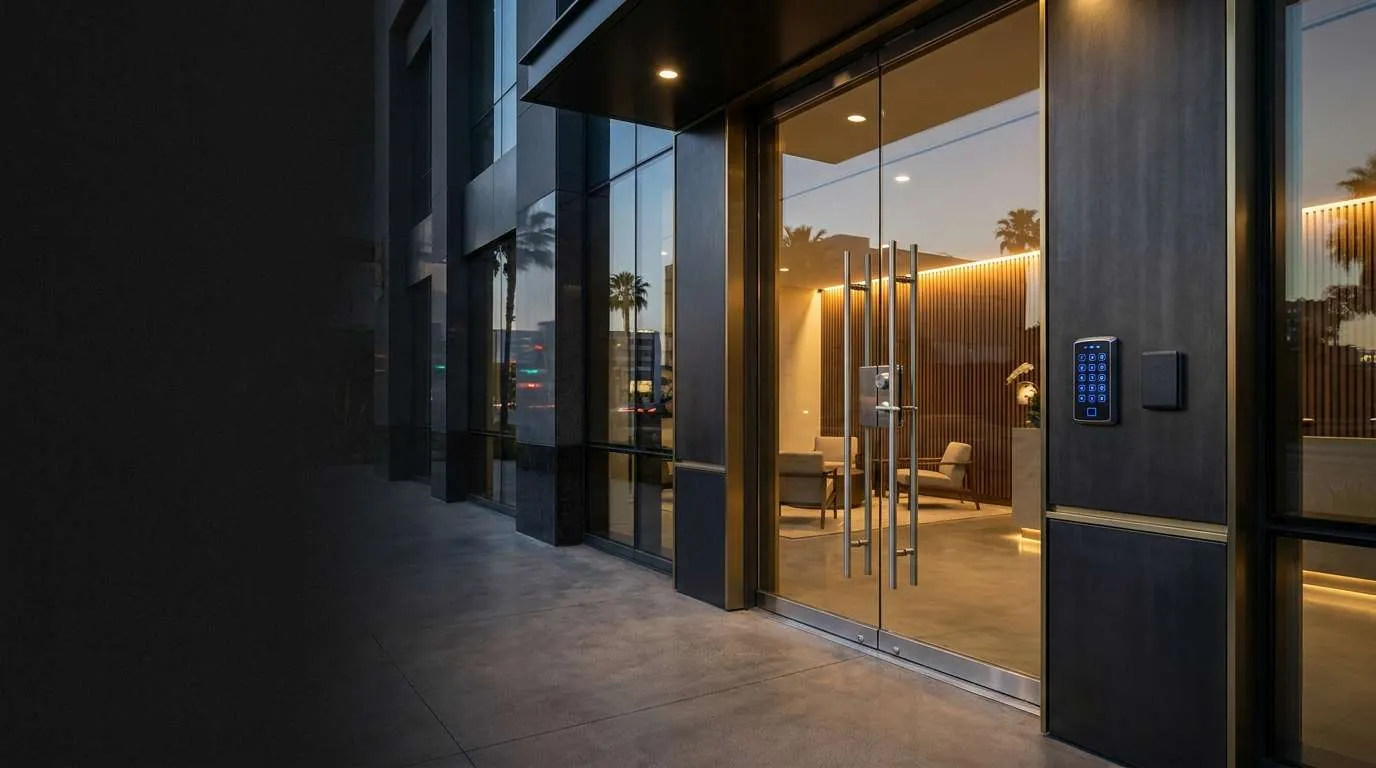
A display frontage is display frontage. It can be laminated or filmed to slow a breach, but it cannot be made solid without defeating its purpose, and everyone including any potential intruder can see exactly what is behind it.
The rear is a different proposition. It is usually unlit, unobserved, and fitted with whatever door the building came with — frequently a hollow or lightly built door in a soft frame, held by residential-grade hardware and a strike plate screwed into the jamb with short screws.
That combination is the weak point on a large proportion of commercial premises, and it costs very little to correct. Commercial-grade hardware, a reinforced strike with screws long enough to reach the framing, and where the door is a required exit, an exit device that actually latches reliably.
Two cheap additions are worth specific mention. A door-position switch on the service door reports whether it is genuinely closed at the end of the night rather than propped or resting on its latch — which is the commonest failure by some distance in premises where staff take breaks out the back. And a camera positioned at the rear approach, where someone has to pass, is worth more than several aimed at open ground.
On the frontage itself, the mundane failure is more common than the dramatic one: a narrow-stile door that has sagged so the hook bolt no longer meets its keeper, leaving a shop unlocked overnight without anybody realising.
Common cases
What premises here call about
A frontage door that no longer locks
Sagging and closer adjustment on narrow-stile hardware.
A service door left propped at night
The commonest real failure, and what door-position switches exist for.
Staff turnover in hospitality
Frequent enough that credentials usually beat keys.
A rear door on residential-grade hardware
Cheap to correct, and usually the weakest point on the premises.
A shared corridor door in a mixed-use building
Should be treated as exterior, and may belong to the building rather than the tenant.
A showroom with high-value stock
Internal securing and rear access do more than frontage upgrades.
Options
Where the money is best spent
Rear and service doors
Commercial-grade hardware and reinforced strikes. The highest-value change on most premises.
Reinforced strikes
Screws long enough to reach framing. Most forced entries split the jamb rather than defeat the lock.
Exit devices
Required exits must latch reliably and permit egress without a key or code.
Door-position switches
Reporting whether a door is genuinely closed at closing time.
Credential access
Where staff turnover is frequent and collecting keys back is unrealistic.
Closer adjustment
The first component to fail on a heavily cycled frontage.
Glazing film
Slows a breach through display glass without changing its appearance.
Camera at the rear approach
Positioned where someone has to pass, not aimed at open ground.
Before you call
What helps when you call
- What kind of premises and roughly how many doors
- Whether the unit is in a mixed-use building
- Who authorises work: owner, tenant, or managing agent
- Whether any door is a required exit
- What the rear and service doors currently have on them
- How many staff hold keys, and how often that changes
- Trading hours, so work can be scheduled around them
- Photographs of the rear door and its frame
Process
How the visit runs
Describe it
The property or vehicle, the hardware involved, and what changed before the problem started.
Confirm the service
We confirm what applies and what the technician needs to bring, including how authorisation will be shown.
Diagnose on site
The hardware and the whole opening are inspected before anything is replaced.
Complete and test
Everything is tested in place before the visit ends.
Common questions
West Hollywood commercial questions
Request commercial locksmith work in West Hollywood
Tell us the premises type, how many doors, and your trading hours so work can be scheduled around them.
Identification is required
For any work that provides access to a property, vehicle or safe, the technician will ask for photo identification and evidence that you are entitled to enter. Having that ready keeps the visit short.