
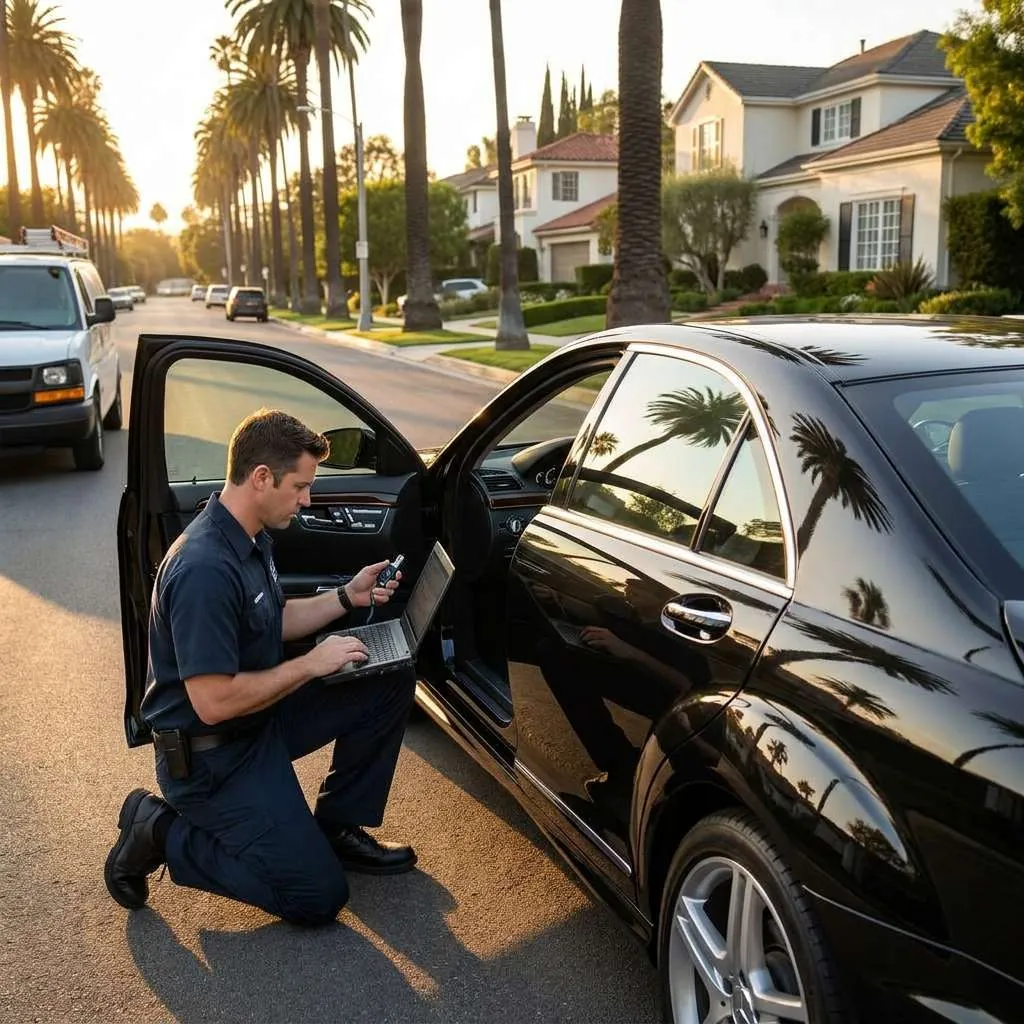
Car keys in Sherman Oaks
Car key replacement in Sherman Oaks, CA
Replacement and spare keys, transponder programming, fob replacement and push-to-start key service — with proof of ownership required before any key is cut or programmed.
Car keys in Sherman Oaks
Replacing a car key is three jobs, not one
A modern car key combines a cut blade, a transponder chip and, usually, a remote. Replacing it means dealing with all three: cutting the metal correctly, programming the chip so the immobiliser accepts it, and pairing the remote functions if the vehicle has them.
Which of those is straightforward depends entirely on whether you still have a working key. With one in hand, the blade can be duplicated or cut from code and the new transponder programmed alongside the existing one. Without any key at all, the cut has to be derived independently — from the key code held against the vehicle identification number, or by decoding a lock on the car — and the immobiliser has to be put into a mode that accepts a new key.
Sherman Oaks generates a steady volume of this work simply because of how the area parks: dense street parking along Ventura Boulevard and its side streets, apartment lots and structures off Moorpark, and hillside driveways where a misplaced key means a walk. Where the vehicle is sitting affects how a visit is arranged, so it is worth being specific.

The cheapest time to make a spare key is before you need one.
In detail
With a working key, and without one
If you still have a key that works, this is a short job. The blade is duplicated or cut from the vehicle's key code, the new transponder is programmed alongside the existing one, and the remote is paired. Most vehicles allow additional keys to be added without any security delay when an accepted key is already present.
If every key is lost, the same result takes considerably longer. The cut has to be derived rather than copied, which means either retrieving the key code against the vehicle identification number or decoding one of the vehicle's own locks. Then the immobiliser has to be persuaded to accept a key it has never seen.
That second step is where many platforms impose a mandatory security delay — a period during which the vehicle will not enter key-learning mode. It can run to tens of minutes and it cannot be shortened by anyone, because its entire purpose is to make this process slow for someone without authority. It is a security feature, not an inefficiency, and it is worth knowing about before the technician arrives.
The practical conclusion is unromantic but worth stating: the cheapest and quickest moment to get a spare key is while you still have a working one.
Common cases
When people in Sherman Oaks ask for a key
The reasons vary, and they affect how long the job takes.
A spare, before it becomes urgent
Much quicker and cheaper while an original exists. The sensible time to do it.
One key left and no backup
A single point of failure. Adding a second key now avoids a much larger job later.
Every key lost
The full process: deriving the cut, programming the immobiliser, and often waiting out a security delay.
A fob that has stopped being recognised
Frequently the battery. If a fresh cell does not fix it, the contacts or the programming are next.
A key damaged or worn
A worn blade can stop turning reliably long before it breaks. Cutting a fresh key from code restores the original profile.
A key snapped in the ignition
Extraction first, then establishing why it broke, then replacement.
Reference
Key types and what each one needs
Times vary by platform rather than by workload. Some vehicles require dealer-level tooling, and where that is the case you will be told rather than left waiting.
| Key type | What replacing it involves | Typically |
|---|---|---|
| Basic mechanical key | Cutting only, no electronics | Quick |
| Transponder key | Cutting plus chip programming | Moderate |
| Remote head key | Cutting, chip programming and remote pairing | Moderate |
| Flip key | As remote head key, with a folding blade mechanism | Moderate |
| Proximity fob | Programming to the vehicle; emergency blade cut if required | Longer |
| All keys lost, any type | Deriving the cut, then immobiliser learning mode | Longest — may include a security delay |
Before you call
What helps when you call
Vehicle work is entirely equipment-dependent, so these details decide whether the right tooling arrives with the technician.
- Year, make and model — and the trim level if you know it
- Whether the vehicle uses a turn key or push-button start
- Whether any working key or fob still exists
- Whether you need remote functions as well as starting
- Where the vehicle is: street, driveway, apartment lot or structure
- Photo identification and proof of ownership
- Whether the vehicle can be left where it is
- Any dashboard warning message, word for word
Process
How the visit runs
Describe it
The property or vehicle, the hardware involved, and what changed before the problem started.
Confirm the service
We confirm what applies and what the technician needs to bring, including how authorisation will be shown.
Diagnose on site
The hardware and the whole opening are inspected before anything is replaced.
Complete and test
Everything is tested in place before the visit ends.
Common questions
Car key questions in Sherman Oaks
Request car key service in Sherman Oaks
Include the year, make and model, and whether any working key remains.
Identification is required
For any work that provides access to a property, vehicle or safe, the technician will ask for photo identification and evidence that you are entitled to enter. Having that ready keeps the visit short.