
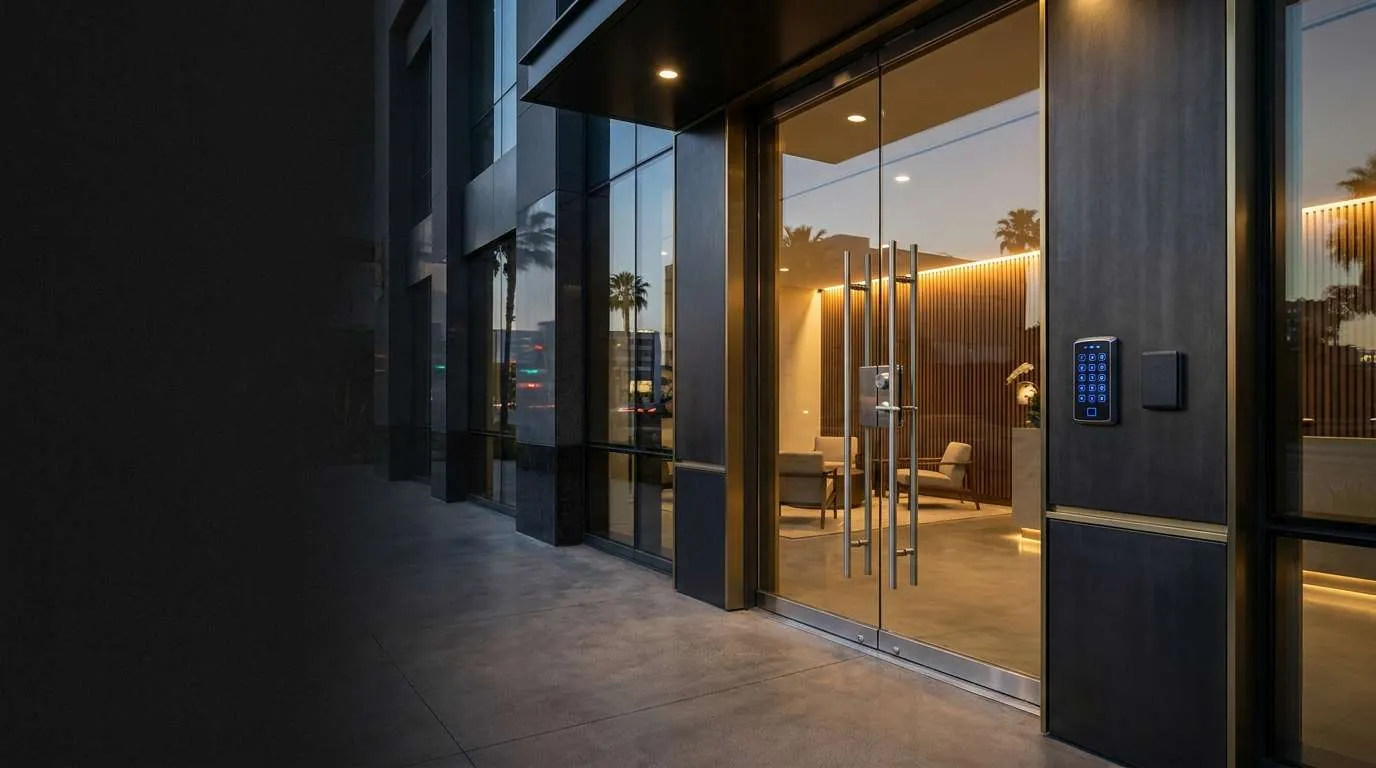
Commercial work in North Hollywood
Commercial locksmith in North Hollywood, CA
Arts district units, converted buildings and mixed-use ground floors — where hardware from several eras frequently sits on the same site.
Commercial work in North Hollywood
Converted buildings and mixed-era hardware
North Hollywood's commercial stock includes a good deal of property that was built for one purpose and is now used for another. Former light industrial buildings hold studios, workshops, theatres and small businesses. Ground floors of new mixed-use developments hold retail and offices. Older commercial parades sit alongside both.
That produces a recognisable situation: a single premises with hardware from three different decades on its doors. Original industrial fittings that are still perfectly serviceable, later additions of variable quality, and whatever the last tenant fitted in a hurry.
The useful first step on these buildings is an assessment of each opening rather than a blanket replacement, because a fair amount of the older hardware is better than anything that would replace it at the same price.
Common cases
Commercial calls in the area
A converted unit with hardware from three eras
Assessed opening by opening rather than replaced wholesale.
A tenant carrying a ring of unmarked keys
A keying scheme, which usually costs less than expected.
A retrofitted exit device that does not latch
Fitted to an opening it does not quite suit, and worth correcting promptly.
A ground-floor unit in a mixed-use building
Where the boundary between unit and building responsibility needs establishing.
A closer that was never sized for its door
Common in conversions, and the cause of doors that slam or fail to latch.
A light industrial unit changing tenants
Rekeying the unit while shared yard and loading access stays with the landlord.
In detail
Assessing a converted building door by door
Older commercial hardware was frequently built to a standard that modern budget fittings do not reach. Heavy mortise lock bodies, substantial lever furniture and solid closers from an earlier era are often repairable, rebuildable and worth keeping. Replacing them with the cheapest current equivalent is a downgrade dressed as an upgrade.
What tends to need attention on these buildings is different: the alignment of doors in frames that have moved, closers that were never sized for the door they are on, exit devices retrofitted to openings they do not quite suit, and cylinders that have been changed piecemeal so no two doors share a key.
The keying question is often the most valuable one. A converted building that has accumulated cylinders over twenty years typically has no coherent scheme at all: the tenant carries a ring of unmarked keys, nobody knows which opens what, and adding a new door means adding a new key. Standardising the keyway and building a small master scheme usually costs less than people expect and removes a daily irritation.
Where a door is a required exit, that constrains what may be fitted regardless of the building's history. Egress cannot be compromised for convenience, and fire-rated assemblies need listed components.

Options
What usually gets done on these buildings
Hardware assessment
Establishing which existing fittings are worth keeping before anything is ordered.
Mortise lock servicing
Stripping and rebuilding heavy older lock bodies rather than replacing them.
Keying scheme
Standardising the keyway so cylinders are interchangeable and a master is possible.
Closer sizing
Matching the closer to the door so the latch actually engages.
Exit device correction
Ensuring required exits latch reliably and permit egress without a key.
Alignment work
Correcting doors and frames that have moved in older buildings.
Credential access
Where several tenants or frequent staff change make keys impractical.
Door-position switches
On service and loading doors where propping is the real risk.
Process
How the visit runs
Describe it
The property or vehicle, the hardware involved, and what changed before the problem started.
Confirm the service
We confirm what applies and what the technician needs to bring, including how authorisation will be shown.
Diagnose on site
The hardware and the whole opening are inspected before anything is replaced.
Complete and test
Everything is tested in place before the visit ends.
Before you call
What helps when you call
- What the building was originally and what it is now
- How many doors are involved and roughly what era they are
- Whether the premises are leased, and who authorises work
- Whether shared access (yard, loading, corridors) is involved
- Whether any door is a required exit or fire-rated
- How many keys are currently in circulation
- Whether any coherent keying scheme exists
- Photographs of the doors and their hardware
Common questions
North Hollywood commercial questions
Request commercial locksmith work in North Hollywood
Tell us what the building is, how many doors are involved and who authorises the work.
Identification is required
For any work that provides access to a property, vehicle or safe, the technician will ask for photo identification and evidence that you are entitled to enter. Having that ready keeps the visit short.